

Scientific Name : Descurainia kenheilii
Author : Al-Shehbaz NatureServe Explorer
Common Name : Heil's Tansy- mustard
 Current Research Activities



☰ Click link below for details.
Taxonomy
Brassicaceae (mustard family)
This species was first described in 2007 (Al-Shehbaz 2007). It was redescribed in 2022 (O'Kane and Heil 2022) as a larger and wider ranging species.
Ranks and Status
State Rank : S2
State Rank Reason : Descurainia kenheilii is endemic to southwestern Colorado (USA), where it is restricted to high elevations in the San Juan Mountains. This short-lived, perennial herb has an interesting story. It was described from a single depauperate specimen in 1997 and not relocated until 2021, when its description was revised and additional specimens were identified: moving this single site endemic to a regional endemic with 7 occurrences. The primary threat to this species is sheep grazing which browse related species of Descurainia. The species habitat may be impacted by climate change through increased shrubby growth or unfavorable climatic conditions.
U.S. Endangered Species Act : none
Colorado Threatened and Endangered List : none
Other Statuses : BLM, SWAP SGIN
Description and Phenology
General Description:
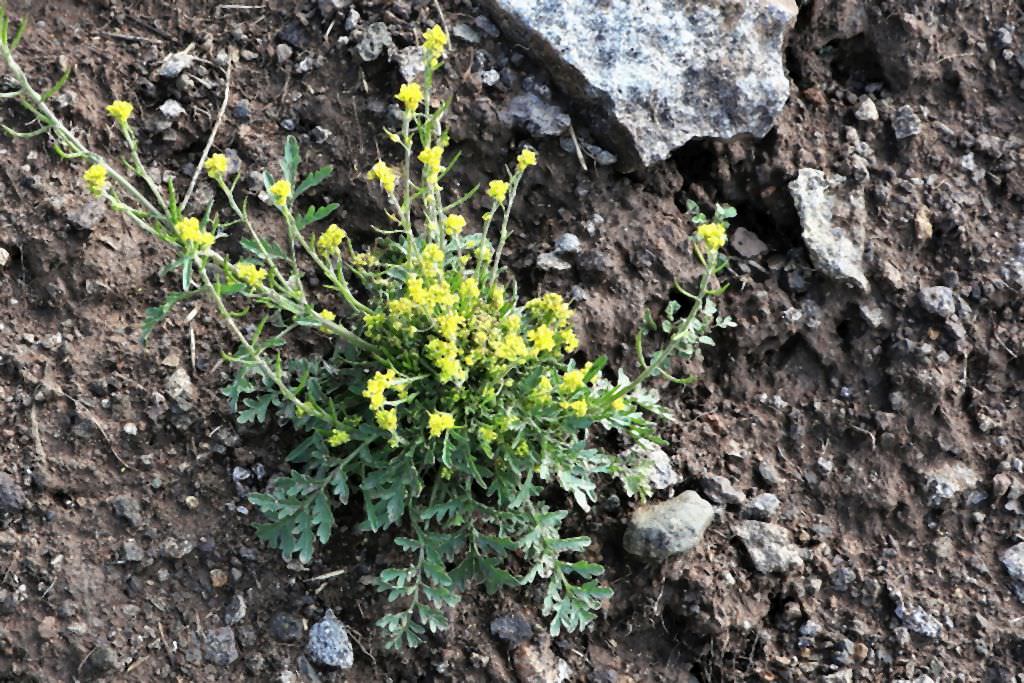
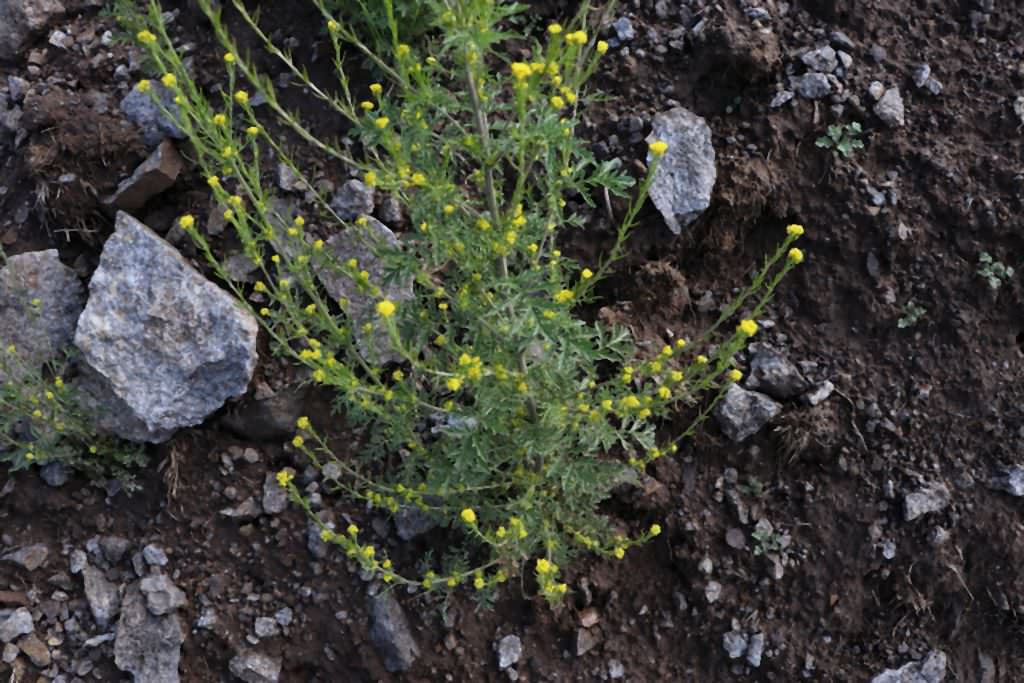
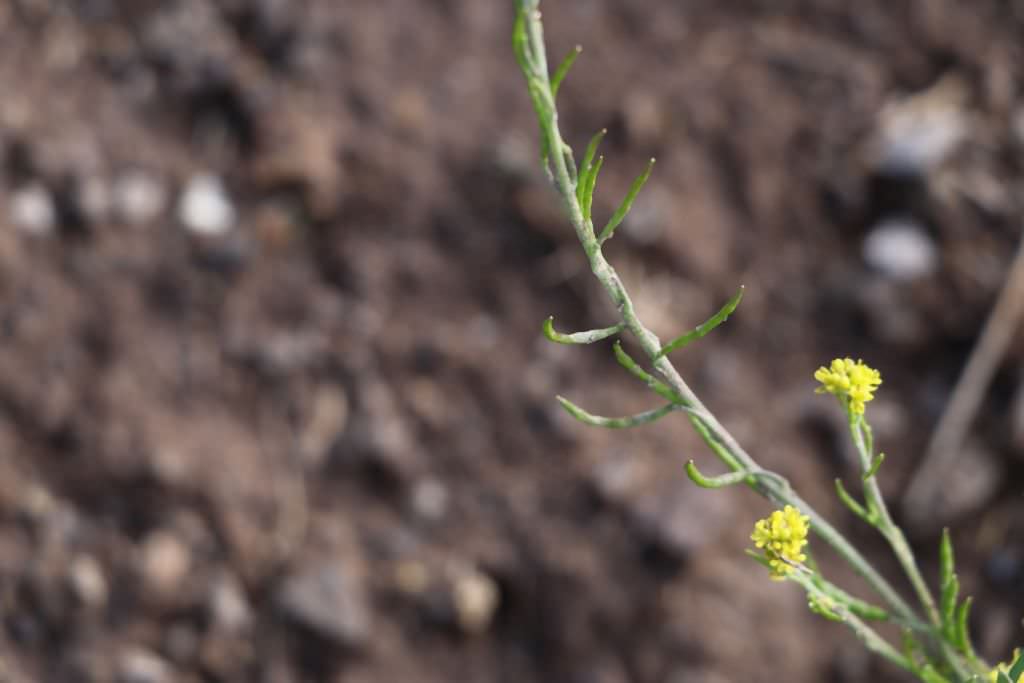
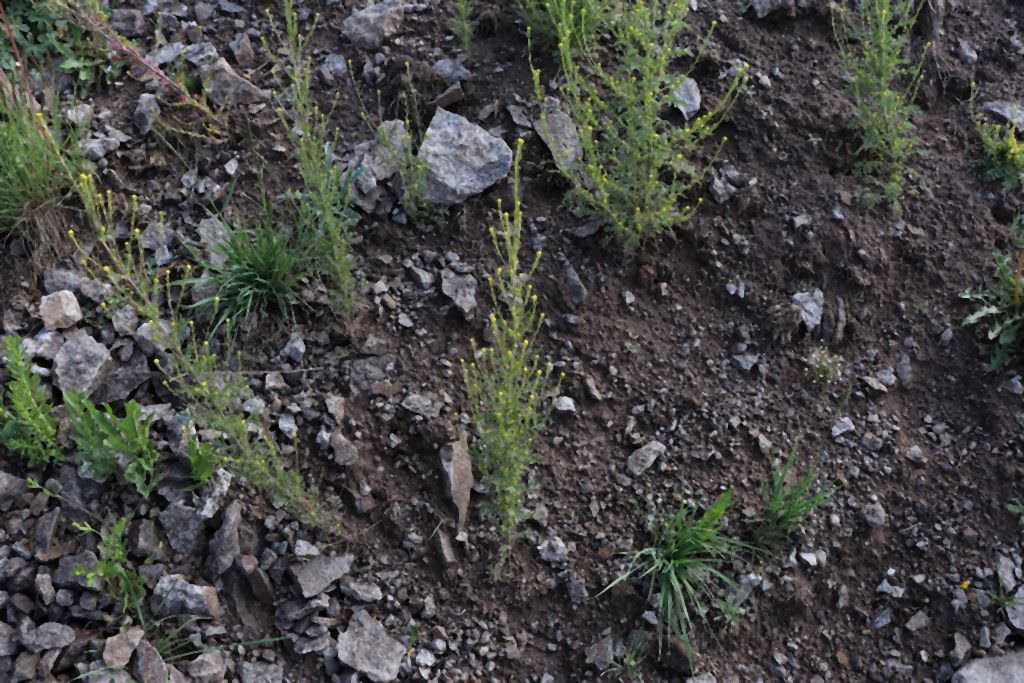
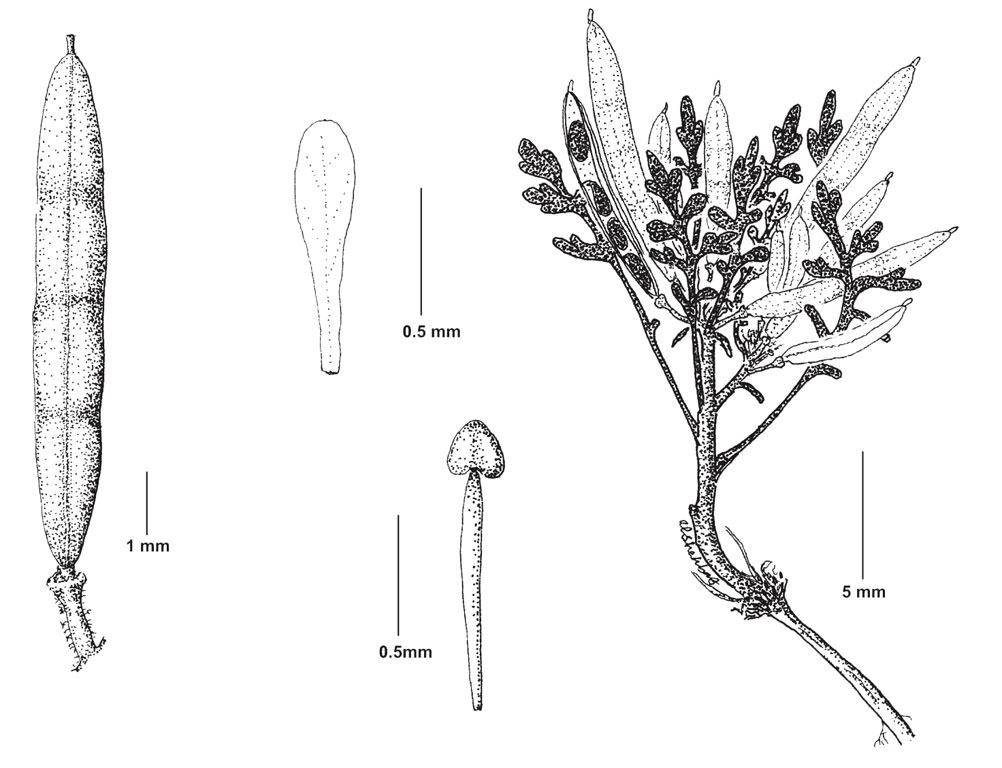
This species was originally described as a diminutive, short-lived perennial 0.1-0.15 dm tall, erect, simple or rarely few branched with yellowish flowers, sparsely pubescent throughout with dendritic trichomes. The basal and lowermost cauline leaves were described as pinnate, and oblanceolate in outline; racemes not elongated in fruit; fruiting pedicels erect to ascending (Al-Shehbaz 2007). The description was revised in 2022 (O'Kane and Heil) as follows: plants short-lived perennials (some biennial); eglandular; glabrescent to sparsely pubescent throughout with dendritic trichomes; stems several, branched from the base and nearly throughout, decumbent to erect; mostly 1.4â11 dm, but when dwarfed, as in the holotype, unbranched and as little as 0.1 dm. Leaves green basally; blade pinnate, oblanceolate to obovate in outline, lateral leaflets 2â5 per side, lateral leaflet lobes 2â4, pinnatifid, rounded. Cauline leaves subsessile, blade smaller distally, distal lobes narrower, surfaces sparsely pubescent to glabrescent. Sepals ascending, yellowish, ovate, 1â1.4 mm, pubescent; petals light yellow, narrowly oblanceolate, 1â1.5 Ã 0.3â0.4 mm; racemes moderately to strongly elongated in fruit except not elongated in dwarfed plants as in the holotype; fruits somewhat torulose; fruiting pedicels ascending to erect, not appressed to the stem (OâKane and Heil 2022).
Look Alikes:
Descuraina incana is biennial; mainly branched in the distal half of the stem (vs. basally); stems single, erect (vs. branched and decumbent to erect); leaves withered and deciduous basally (vs. green basally); growing from low to high elevations (vs. above 3150 m); ovules 4-8 per ovary (vs. 6-22), fruits nearly smooth to torulose (vs. torulose), fruiting pedicels ascending to erect (vs. divergent to ascending), fruits erect, often nearly appressed to the stems (vs. not at all appressed) (O'Kane and Heil 2022). Descuraina kenheilii is distinguished from D. torulosa, by having glabrous (vs. sparsely pubescent) fruit valves and styles, prominently veined (vs. veinless) septa, 4-8 (vs. 10-18) seeds and ovules per fruit, uniseriate (vs. biseriate) seeds, straight (vs. curved outward) and non-appressed (vs. basally appressed) fruits 1.0-1.3 (vs. 0.6-0.8) mm wide, and not elongated (vs. considerably elongated) fruiting racemes (Al-Shehbaz 2007). The broad pinnate leaflets of D. kenheilii are distinctive.
Phenology:
The type specimen of this species was collected with flowers and fruit on September 13, 1997 (CNHP 2012). The revised description of the species indicates that flowering of representative specimens occurs from July to September (O'Kane and Heil 2022).
 |
Habitat
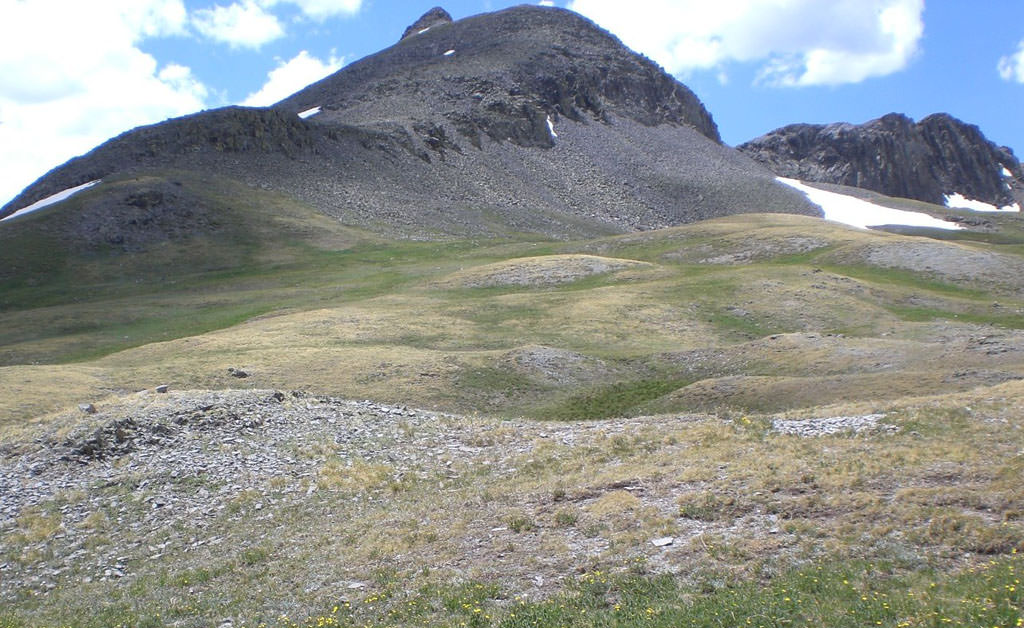
This species occurs in alpine tundra, talus slopes, and rock outcrops on an andesite porphyry and rhyolite tuff substrate in both undisturbed and disturbed areas; plants are taller and more robust where well-watered and with little competition (Al-Shehbaz 2007, O'Kane and Heil 2022). Associated species include Carex spp., Salix spp., Geum rossii var. turbinatum, Castilleja occidentalis, Castilleja rhexifolia var. rhexifolia, Deschampsia cespitosa, Mimulus guttatus, Heracleum, Epilobium leptocarpum and Alopecurus aequalis (CNHP 2022).
click on image to enlarge
 |
Elevation Range:
10,163 - 12,994 feet (3,098 - 3,961 meters)
Distribution
Colorado Endemic:
Yes
Range:
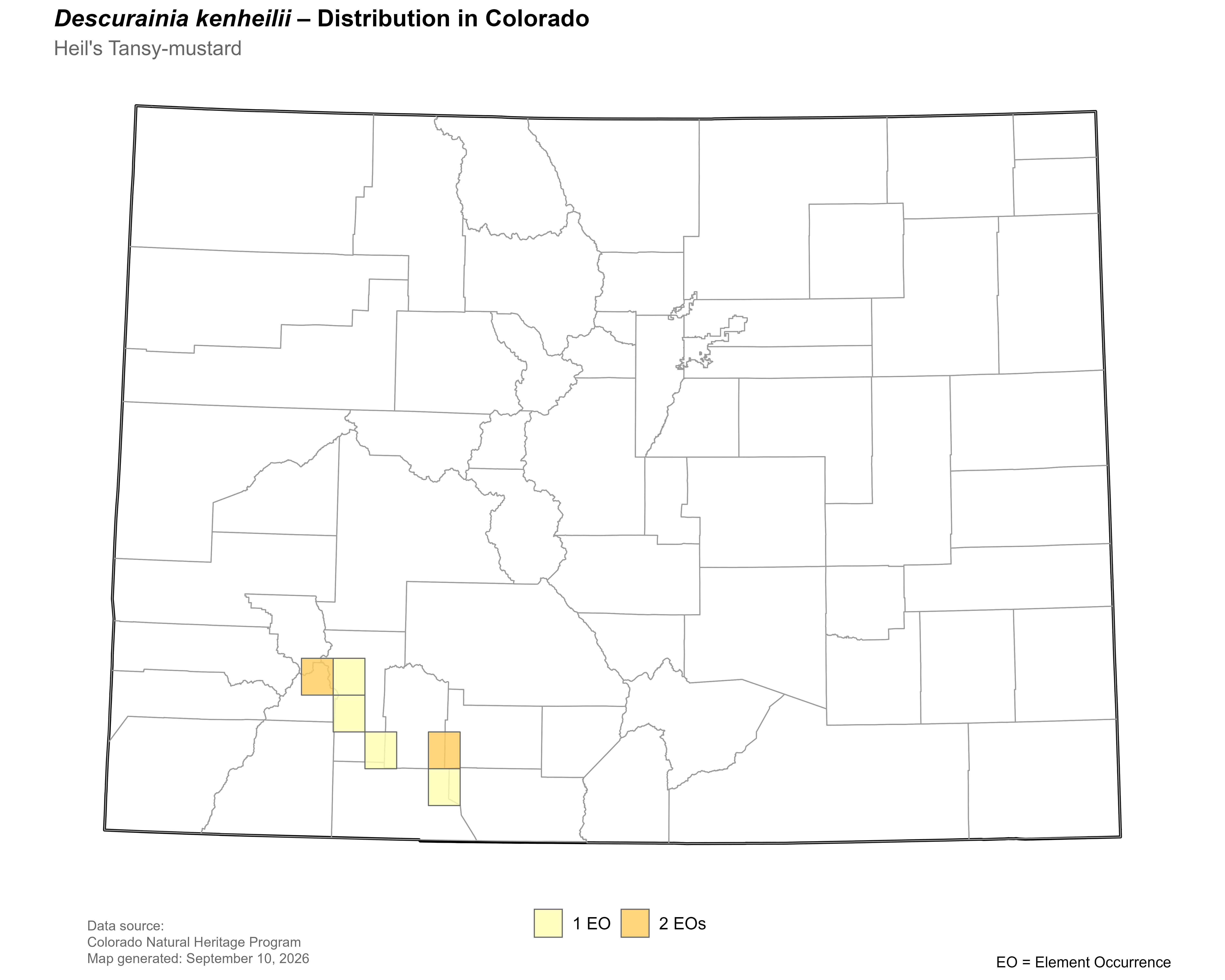
Descurainia kenheilii is endemic to southwestern Colorado (USA), where it occurs in the San Juan Mountains (Al-Shehbaz 2007). Rediscovery of this species in 2021 led to a better understanding of its morphology, as the type specimen was depauperate. In turn, knowledge of the distribution improved and expanded to include Conejos, Hinsdale, Mineral, Rio Grande, and San Juan counties (O'Kane and Heil 2022). This species is reported in error from Archuleta County (J. Ackerfield, pers. comm., 2021, I. Al-Shehbaz, pers. comm., 2021, Ackerfield 2015, FNA 2010). Descurainia kenheilii is likely endemic to high elevations in the San Juan Mountains, where Descurainia incana is found in the region at lower elevations, comparatively (O'Kane and Heil 2022). Range extent was calculated at 1,618 sq km based on specimens identified as D. kenheilii (O'Kane and Heil 2022).
Click on map to enlarge |
Threats and Management Issues
There is sheep grazing and recreational activities at the type location. Other species of Descurainia at the site are grazed (J. Ackerfield, pers. comm., 2021) and it is likely that Descurainia kenheilii would also be impacted by grazing. The impact of recreational activities is unknown, but it occurs near a gravel road used by off road vehicles (ORVs) and the Continental Divide National Scenic Trail. Alpine species may be particularly vulnerable to climate change which may result in increased shrubby growth or unfavorable climatic conditions. This species is considered to be extremely vulnerable to climate change (Handwerk et al. 2015).
References
- Ackerfield, J. 2015. Flora of Colorado. BRIT Press, Botanical Research Institute of Texas, Fort Worth, TX. 818 pp.
- Al-Shehbaz, I.A. 2007. Descurainia kenheilii (Brassicaceae), A new species from the San Juan Mountains, Colorado. Harvard Papers in Botany 12(2): 395-396.
- Colorado Natural Heritage Program (CNHP). 2022. Biodiversity Tracking and Conservation System (Biotics 5). Colorado Natural Heritage Program, Colorado State University, Fort Collins.
- Flora of North America Editorial Committee, ed. (FNA). 1993+. Flora of North America North of Mexico. Oxford Univ. Press, New York, Oxford.
- Handwerk, J., L. Grunau, and S. Panjabi. 2015. Colorado Wildlife Action Plan: 2015 Rare Plant Addendum. Colorado Natural Heritage Program, Colorado State University, Fort Collins, Colorado, USA.
- Heil, K.D., S.L. O'Kane Jr., L.M. Reeves, and A. Clifford, 2013. Flora of the Four Corners Region, Vascular Plants of the San Juan River Drainage; Arizona, Colorado, New Mexico, and Utah. Missouri Botanical Garden Press, St. Louis, Missouri. 1098 pp.
- Lavender, A.E., M.M. Fink, S.E. Linn, D.M. Theobald. 2011. Colorado Ownership, Management, and Protection v9 Database. Colorado Natural Heritage Program and Geospatial Centroid, Colorado State University, Fort Collins, CO. (30 September).
- Neely, B., S. Panjabi, E. Lane, P. Lewis, C. Dawson, A. Kratz, B. Kurzel, T. Hogan, J. Handwerk, S. Krishnan, J. Neale, and N. Ripley. 2009. Colorado Rare Plant Conservation Strategy, Developed by the Colorado Rare Plant conservation Initiative. The Nature Conservancy, Boulder, Colorado, 117 pp.
- O'Kane, S.L., and K.D. Heil. 2022. Descurainia kenheilii (Brassicaceae): Revised description and new records from Colorado. Phytologia 104(2): 4-7.
- Weber, W. A. and R. C. Wittmann. 2012. Colorado Flora, Western Slope, A Field Guide to the Vascular Plants, Fourth Edition. Boulder, Colorado. 532 pp.
Biotics Export Date : September, 2026