


Scientific Name : Delphinium alpestre
Author : Rydb. NatureServe Explorer
Common Name : Colorado Larkspur
 Current Research Activities


☰ Click link below for details.
Taxonomy
Ranunculaceae (buttercup family)
Ackerfield (2015, 2022) recognizes Delphinium alpestre based on smaller size and alpine habitat. Weber and Wittmann (2012) include Delphinium ramosum var. alpestre more broadly under D. ramosum (i.e., they do not distinguish the variety). Weber and Wittmann (2012) place the genus Delphinium in the Helleboraceae (Hellebore Family).
Ranks and Status
State Rank : S2
State Rank Reason : Delphinium alpestre is known from 20 occurrences in the high alpine meadows of south central Colorado, USA. This species occurs in alpine habitat where threats may include accidental trampling by hikers and habitat alteration due to the effects of climate change.
U.S. Endangered Species Act : none
Colorado Threatened and Endangered List : none
Other Statuses : SWAP SGIN, USFS RGNF
Description and Phenology
General Description:
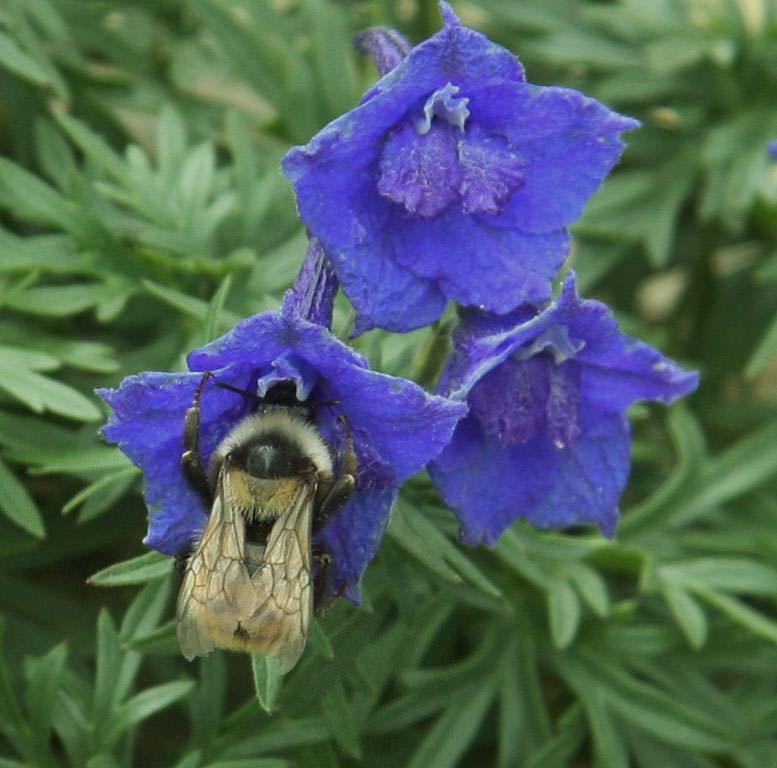
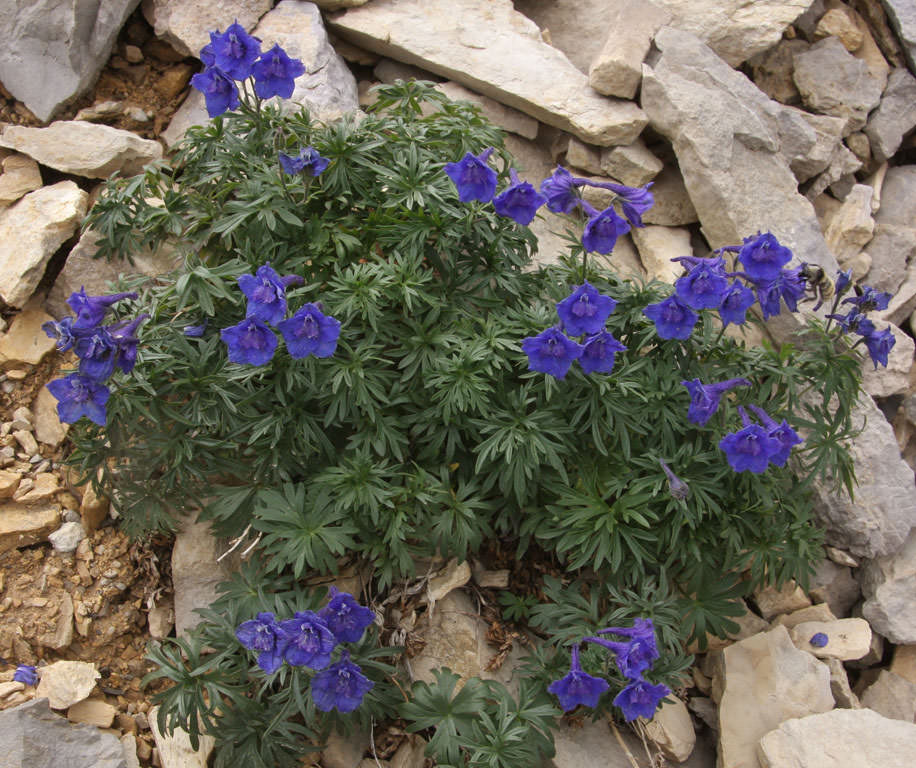
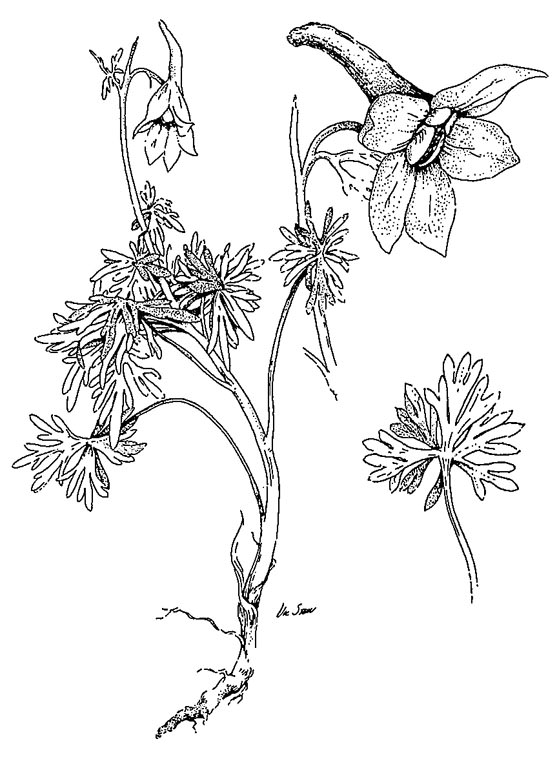
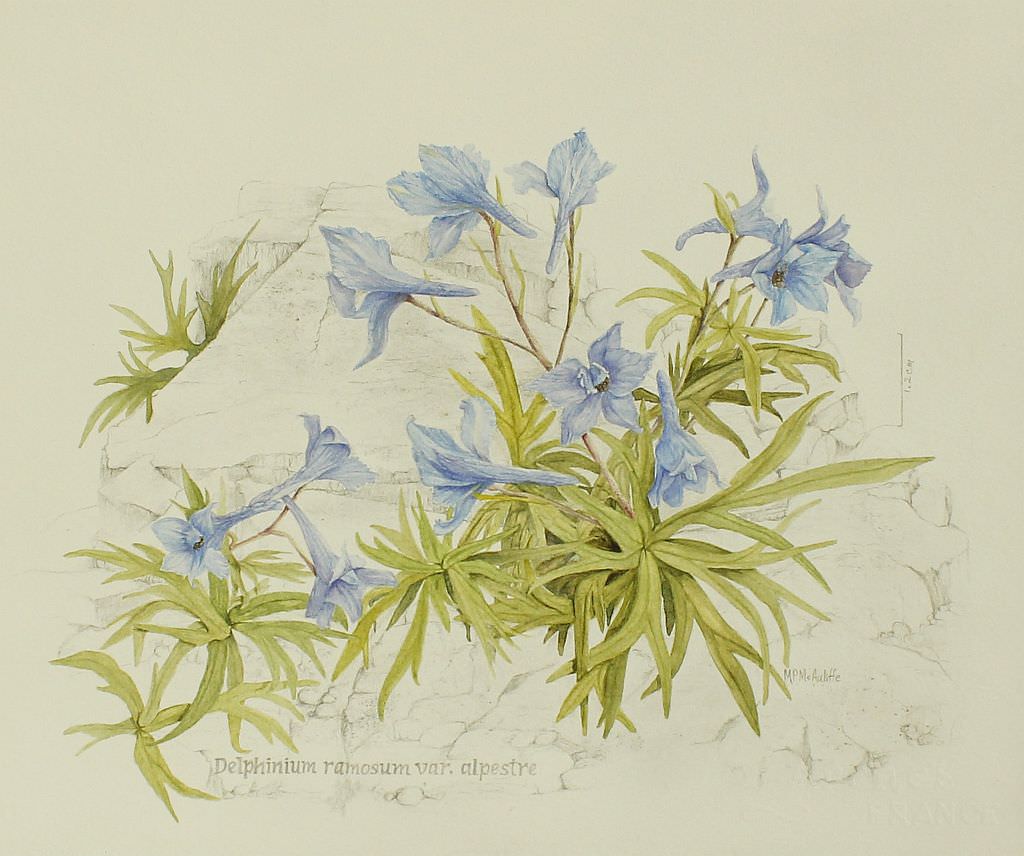
Perennial herb 5-25 cm tall; leaves all on stem, but crowded near base, petioles 1-10 cm long, blades 2-5 cm long and about as wide, palmately divided into 5 main lobes, each lobe further dissected into smaller lobes; inflorescence a raceme of 2-8 flowers; sepals dull blue or dull blue tinged with brown, especially on the back, spreading or forward-pointing, 11-14 mm long, the upper sepal extended basally into a spur 8-12 mm long; lower petal blades cleft, 4-6 mm long (New Mexico Rare Plant Technical Council 1999).
Look Alikes:
Closely related to Delphinium ramosum. This variety is smaller, and occurs at higher elevations.
Phenology:
Flowers mid July to mid August (September) (Colorado Natural Heritage Program 2012).
 |  |
Habitat
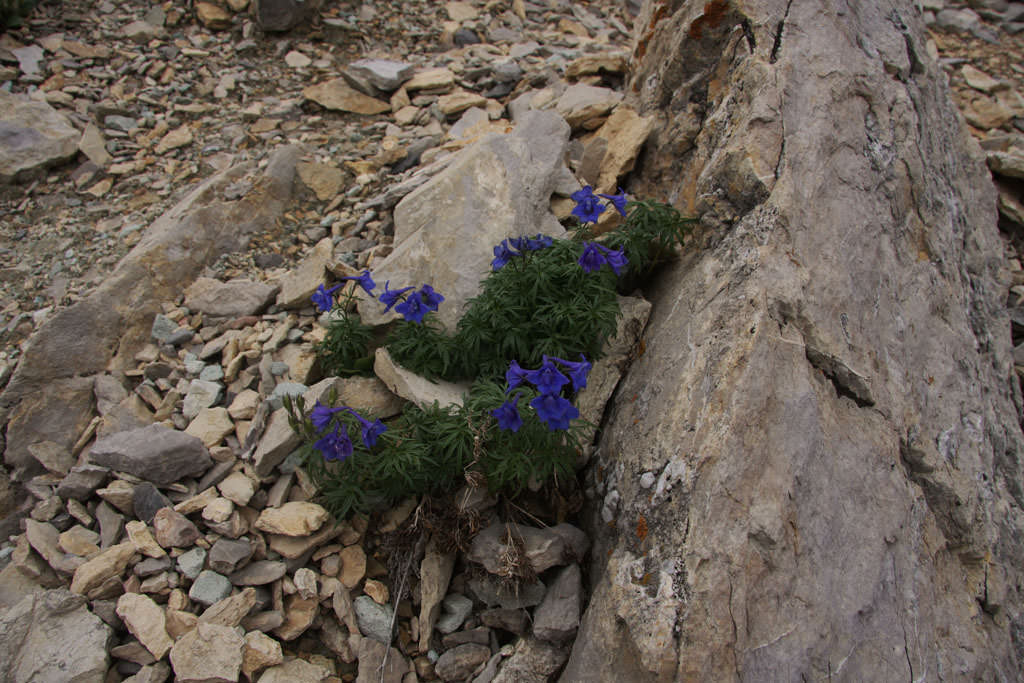
Open alpine meadows and talus slopes. Associated plant species include: Packera cana, Polemonium viscosum, Heuchera parvifolia, Sedum integrifolium.
click on image to enlarge
 |
Elevation Range:
10,202 - 13,653 feet (3,110 - 4,161 meters)
Distribution
Colorado Endemic:
No
Range:
Delphinium alpestre is known from Chaffee, Costilla, Fremont, Huerfano, Las Animas, Mineral, Park, Saguache, and Summit counties in Colorado, USA. Estimated range extent in Colorado of 21,466 square kilometers was calculated in GeoCAT using occurrence data provided by the Colorado Natural Heritage Program (2023). The species is also known from northern New Mexico, USA.
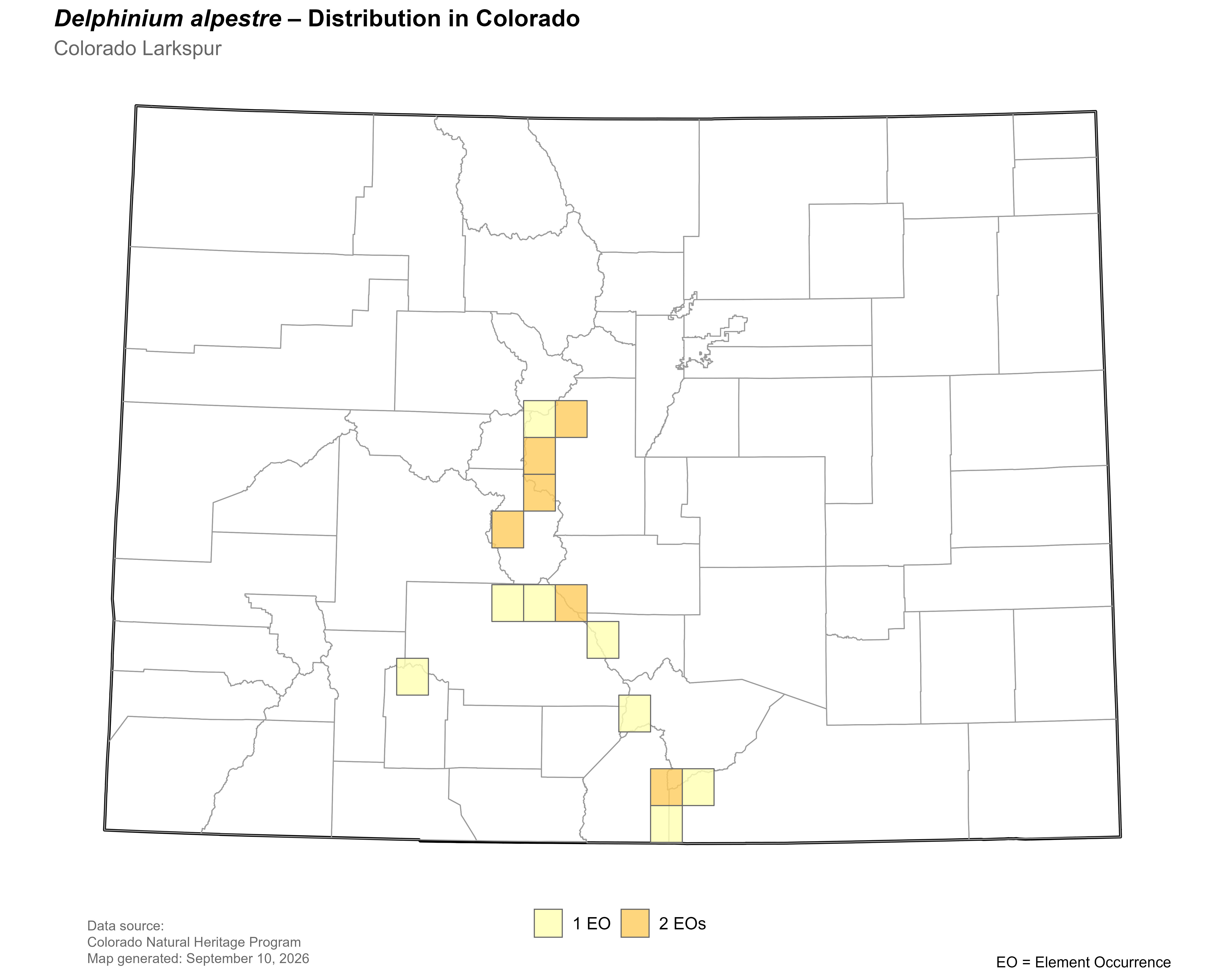
Click on map to enlarge |
Threats and Management Issues
The primary threat at this time is considered to be recreation/hiking (Rondeau et al. 2011). It is not known if all of the occurrences are or are not threatened by these activities. This species occurs in alpine habitat where threats may include accidental trampling by hikers and habitat alteration due to global warming. This species is considered to be extremely vulnerable to climate change (Handwerk et al. 2015).
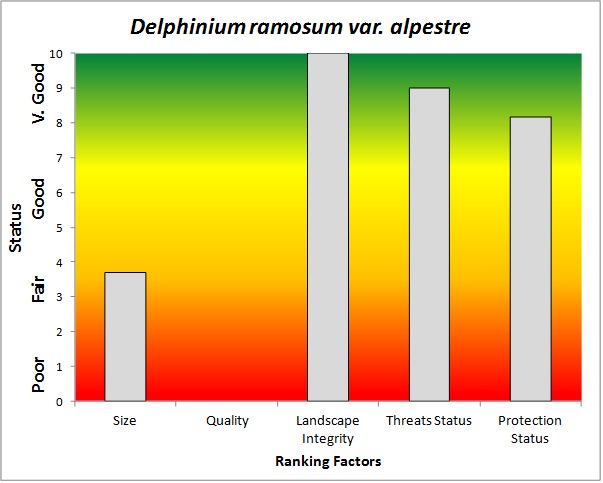
Summary results of an analysis of the status of Delphinium ramosum var. alpestre based on several ranking factors. This species was concluded to be Effectively Conserved. From Rondeau et al. 2011. |
References
- Ackerfield, J. 2012. The Flora of Colorado. Colorado State University Herbarium. 433 pp.
- Ackerfield, J. 2015. Flora of Colorado. BRIT Press, Botanical Research Institute of Texas, Fort Worth, TX. 818 pp.
- Ackerfield, Jennifer. 2022. Flora of Colorado. Second Edition. Bot. Misc. 60. BRIT Press, Fort Worth Botanic Garden/Botanical Research Institute of Texas, U.S.A. 861 pp.
- Colorado Natural Heritage Program. 2012. Biodiversity Tracking and Conservation System. Colorado State University, Fort Collins, CO.
- Handwerk, J., L. Grunau, and S. Panjabi. 2015. Colorado Wildlife Action Plan: 2015 Rare Plant Addendum. Colorado Natural Heritage Program, Colorado State University, Fort Collins, Colorado, USA.
- Harrington, H.D. 1954. Manual of the plants of Colorado. Sage Press, Chicago. 666 pp.
- Lavender, A.E., M.M. Fink, S.E. Linn, D.M. Theobald. 2011. Colorado Ownership, Management, and Protection v9 Database. Colorado Natural Heritage Program and Geospatial Centroid, Colorado State University, Fort Collins, CO. (30 September).
- Martin, W.C., and C.R. Hutchins. 1980-1981. A flora of New Mexico. 1980, Vol. 1; 1981, Vol. 2. J. Cramer, in der A.R. Gantner Verlag, K.G., Vaduz, Liechtenstein. 2591 pp.
- Neely, B., S. Panjabi, E. Lane, P. Lewis, C. Dawson, A. Kratz, B. Kurzel, T. Hogan, J. Handwerk, S. Krishnan, J. Neale, and N. Ripley. 2009. Colorado Rare Plant Conservation Strategy, Developed by the Colorado Rare Plant conservation Initiative. The Nature Conservancy, Boulder, Colorado, 117 pp.
- New Mexico Native Plant Protection Advisory Committee. 1984. A handbook of rare and endemic plants of New Mexico. Univ. New Mexico Press, Albuquerque. 291 pp.
- Rondeau, R., K. Decker, J. Handwerk, J. Siemers, L. Grunau, and C. Pague. 2011. The state of Colorado's biodiversity 2011. Prepared for The Nature Conservancy. Colorado Natural Heritage Program, Colorado State University, Fort Collins, Colorado.
- USDA, NRCS. 2022. The PLANTS Database. National Plant Data Team, Greensboro, NC 27401-4901 USA.
- Weber, W. A. and R. C. Wittmann. 2012. Colorado Flora, Eastern Slope, A Field Guide to the Vascular Plants, Fourth Edition. Boulder, Colorado. 555 pp.
- Weber, W. A. and R. C. Wittmann. 2012. Colorado Flora, Western Slope, A Field Guide to the Vascular Plants, Fourth Edition. Boulder, Colorado. 532 pp.
Biotics Export Date : September, 2026


