


Scientific Name : Cleomella multicaulis
Author : (Candolle) J.C. Hall & E.H. Roalson NatureServe Explorer
Common Name : Slender Spiderflower
 Current Research Activities
 1997 profile
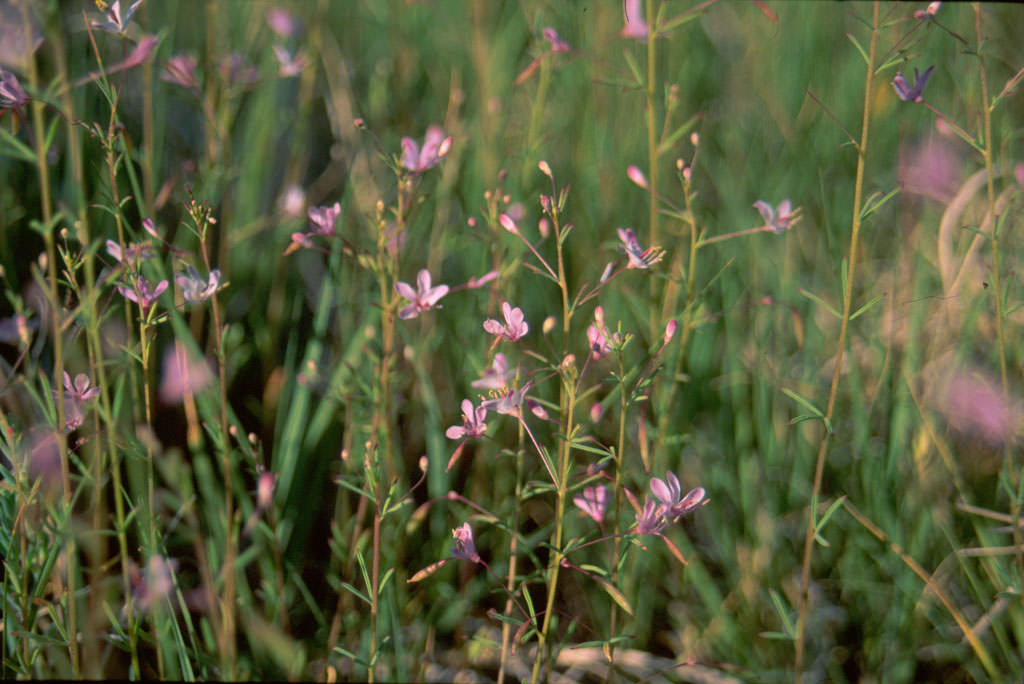
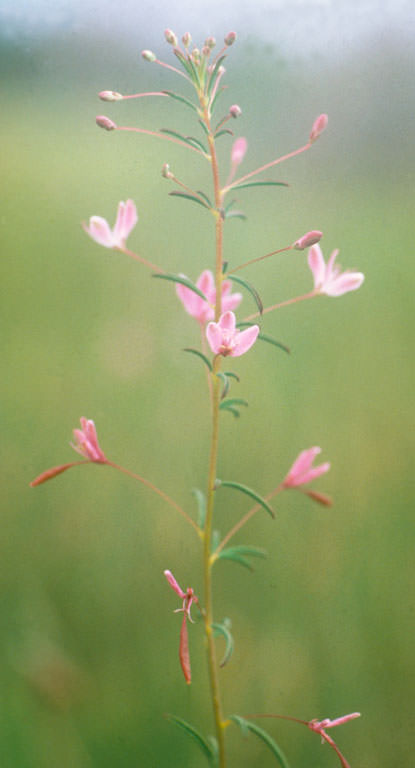
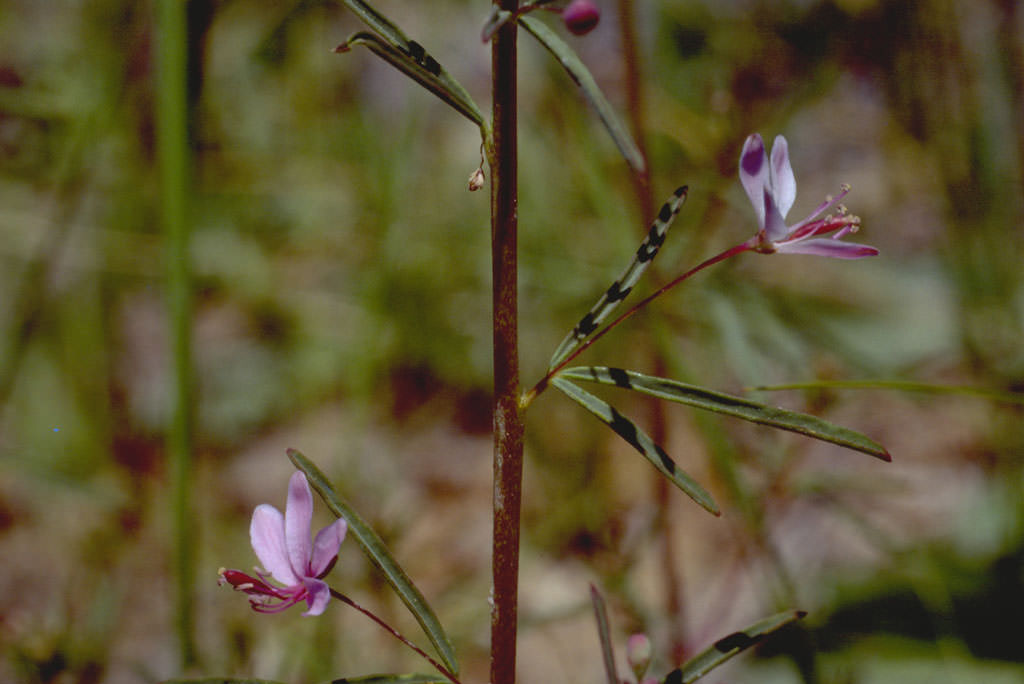


☰ Click link below for details.
Taxonomy
Cleomaceae ()
Ackerfield (2022) lists this as Cleomella multicaulis and Ackerfield (2015) lists this as Cleome multicaulis. The Flora of North America (1993+) and Weber and Wittmann (2012) place Cleome multicaulis in the genus Peritoma.
Ranks and Status
State Rank : S2S3
State Rank Reason : Cleomella (Cleome) multicaulis is known from the San Luis Valley in southern Colorado, USA. There are 37 occurrences, but only 7 are of good or excellent viability, and 22 are known only from historical observations. The primary threat to C. multicaulis is considered to be hydrologic alteration; competition from invasive plant species and incompatible livestock grazing is also a concern at some sites. Cleomella multicaulis is also considered to be vulnerable to the effects of climate change.
U.S. Endangered Species Act : none
Colorado Threatened and Endangered List : none
Other Statuses : BLM, SWAP Tier 1
Description and Phenology
General Description:
Cleome multicaulis is a slender annual forb with erect, unbranched or sparingly branched leafy stems 2-7 dm tall, and glabrous. Leaves are short-petioled and palmately compound with 3 narrow leaflets 1-2 cm long and less than 1.5 mm wide, and may be folded along the midrib. Flowers have 4 pink or pinkish-white petals 4-6 mm long and are borne on thin stalks in the axils of reduced leaves. The 6 stamens are equal in length to the petals. Fruits are narrow capsules 6-18 mm long, tapering to a stalk-like base (gynophore), and droop at maturity (Flora of North America 1993+; Spackman et al. 1997; Weber and Wittmann 2012; Culver and Lemly 2013).
Look Alikes:
Cleome serrulata is more robust, with wider leaflets (5-10 mm), larger flowers with stamens exceeding the petals, and larger fruits (Spackman et al. 1997).
Phenology:
Flowering on branches first occurs next to stem and progresses terminally (Graff 1992). Flowers and fruit June through August (Ackerfield 2012, Colorado Natural Heritage Program 2012).
Habitat
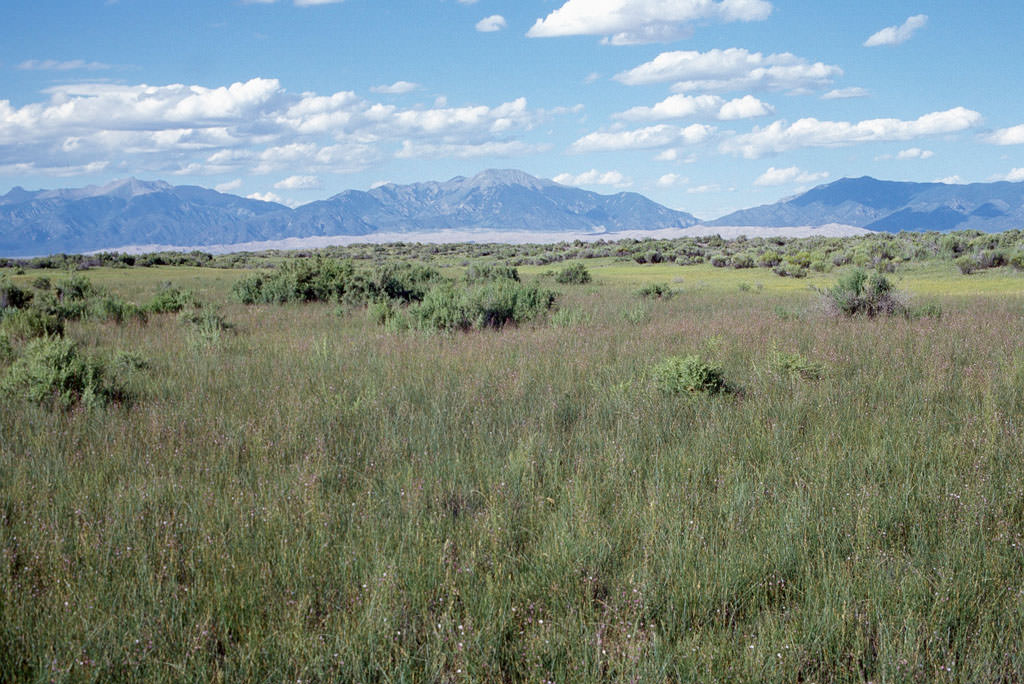
Cleome multicaulis is restricted to saline or alkaline soils, around alkali sinks, ponds, alkaline meadows, or old lake beds. The surrounding plant community is saline bottomland shrubland (dominated by Sarcobatus and Chrysothamnus). The plant often grows in bands just above rushes (Juncus sp.) and may extend into greasewood and saltgrass (Graff 1992, Spackman et al. 1997, Colorado Natural Heritage Program 2013).
click on image to enlarge
 |
Elevation Range:
7,478 - 8,191 feet (2,279 - 2,497 meters)
Distribution
Colorado Endemic:
No
Range:
Cleomella (Cleome) multicaulis is known from Alamosa, Conejos, Costilla, Rio Grande, and Saguache counties in Colorado, USA. Estimated range extent in Colorado of 3,690 square kilometers was calculated in GeoCAT using occurrence data provided by the Colorado Natural Heritage Program (2023). This species can also be found in Arizona, New Mexico, Texas, and Wyoming.
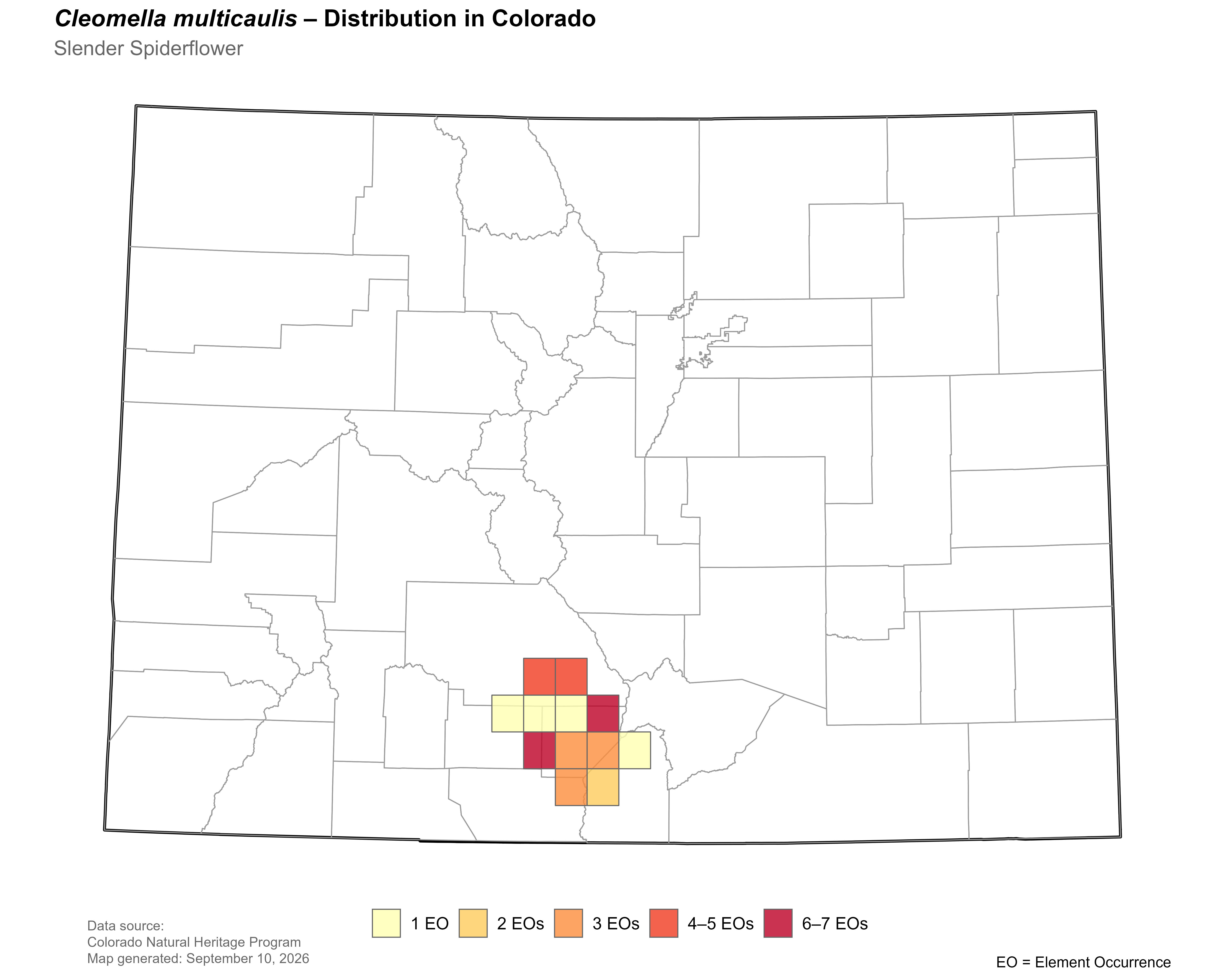
Click on map to enlarge |
Threats and Management Issues
Rangewide, the primary threat to Cleomella multicaulis is considered to be hydrologic alteration (Rondeau et al. 2011). Ongoing and future water developments in the San Luis Valley are likely to have a negative impact on Cleomella multicaulis habitat by lowering the water table. Twenty percent of the occurrences already indicate the local hydrology has dried or been manipulated. Nearly 40% of the occurrences are in heavily grazed sites and inappropriate livestock grazing has been detrimental, increasing the nutrient load in saturated soils and trampling plants, however, light grazing appears to be tolerated. Invasive plant species including Cirsium arvense (Canada thistle), Acroptilon repens (Russian knapweed), Salsola tragus (Russian thistle) and Kochia scoparia (Kochia) are encroaching on Cleomella multicaulis habitat throughout the San Luis Valley. Several occurrences are on private land that has been subdivided and may be impacted by exurban development. This species is considered to have moderate adaptive capacity and is expected to be moderately to extremely vulnerable to climate change under both RCP 4.5 and 8.5 scenarios, as assessed for the 2025 Colorado State Wildlife Action Plan (CNHP 2025).
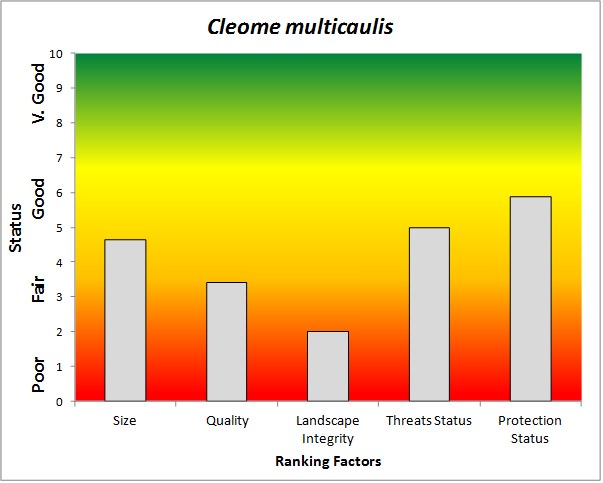
Summary results of an analysis of the status of Cleome multicaulis based on several ranking factors. This species was concluded to be effectively conserved. From Rondeau et al. 2011. |
References
- Ackerfield, J. 2015. Flora of Colorado. BRIT Press, Botanical Research Institute of Texas, Fort Worth, TX. 818 pp.
- Ackerfield, J. 2022. Flora of Colorado. Second Edition. Bot. Misc. 60. BRIT Press, Fort Worth Botanic Garden/Botanical Research Institute of Texas, U.S.A. 861 pp.
- Colorado Native Plant Society. 1989. Rare plants of Colorado. Rocky Mountain Nature Association, Colorado Native Plant Society, Estes Park, Colorado. 73 pp.
- Colorado Natural Heritage Program (CNHP). 2023. Biodiversity Tracking and Conservation System (Biotics 5). Colorado Natural Heritage Program, Colorado State University, Fort Collins.
- Colorado Natural Heritage Program (CNHP). 2025. Climate Change Vulnerability Assessment of Colorado Tier 1 and Tier 2 Plant Species of Greatest Conservation Need (SCGN) for the 2025 Colorado State Wildlife Action Plan. Colorado Natural Heritage Program, Colorado State University, Fort Collins.
- Culver, D.R. and J.M. Lemly. 2013. Field Guide to Colorado's Wetland Plants; Identification, Ecology and Conservation. Colorado Natural Heritage Program, Colorado State University, Fort Collins, 694 pp.
- Fertig, W., C. Refsdal, and J. Whipple. 1994. Wyoming rare plant field guide. Wyoming Rare Plant Technical Committee, Cheyenne. No pagination.
- Flora of North America Editorial Committee (FNA). 2010. Flora of North America north of Mexico. Vol. 7. Magnoliophyta: Salicaceae to Brassicaceae. Oxford University Press, New York. xxii + 797 pp.
- Graff, D. 1992. Staus Report for Cleome multicaulis on Blanca Wetlands. Unpublished manuscript.
- Handwerk, J., L. Grunau, and S. Panjabi. 2015. Colorado Wildlife Action Plan: 2015 Rare Plant Addendum. Colorado Natural Heritage Program, Colorado State University, Fort Collins, Colorado, USA.
- Iltis, H.H. 1958. Studies in the Capparidaceae 5. Capparidaceae of New Mexico. Southwest Naturalist 3: 133-144.
- Luce, S. L. 1983. A study of the pollination ecology and reproductive strategies of Cleome serrulata (Pursh). M.S. Thesis, University of Wyoming.
- Neely, B., S. Panjabi, E. Lane, P. Lewis, C. Dawson, A. Kratz, B. Kurzel, T. Hogan, J. Handwerk, S. Krishnan, J. Neale, and N. Ripley. 2009. Colorado Rare Plant Conservation Strategy, Developed by the Colorado Rare Plant conservation Initiative. The Nature Conservancy, Boulder, Colorado, 117 pp.
- New Mexico Native Plant Protection Advisory Committee. 1984. A handbook of rare and endemic plants of New Mexico. Univ. New Mexico Press, Albuquerque. 291 pp.
- O'Kane, S.L. 1988. Colorado's rare flora. Great Basin Naturalist 48(4): 434-484.
- Rondeau, R., K. Decker, J. Handwerk, J. Siemers, L. Grunau, and C. Pague. 2011. The state of Colorado's biodiversity 2011. Prepared for The Nature Conservancy. Colorado Natural Heritage Program, Colorado State University, Fort Collins, Colorado.
- Spackman, S., B. Jennings, J. Coles, C. Dawson, M. Minton, A. Kratz, and C. Spurrier. 1997. Colorado rare plant field guide. Prepared for Bureau of Land Management, U.S. Forest Service and U.S. Fish and Wildlife Service by Colorado Natural Heritage Program.
- USDA, NRCS. 2022. The PLANTS Database. National Plant Data Team, Greensboro, NC 27401-4901 USA.
- Weber, W. A. and R. C. Wittmann. 2012. Colorado Flora, Eastern Slope, A Field Guide to the Vascular Plants, Fourth Edition. Boulder, Colorado. 555 pp.