


Scientific Name : Astragalus tortipes
Author : J. L. Anderson & J. M. Porter NatureServe Explorer
Common Name : Sleeping Ute Milkvetch
 Current Research Activities
 1997 profile
☰ Click link below for details.
Taxonomy
Fabaceae (pea family)
Ranks and Status
State Rank : S1
State Rank Reason : Astragalus tortipes is only known from an area of about 10 square kilometers in extreme southwestern Colorado, USA. Motorized recreation, development associated with water diversions, and the effects of climate change are considered to be the primary threats to the species.
U.S. Endangered Species Act : none
Colorado Threatened and Endangered List : none
Other Statuses : SWAP Tier 1
Description and Phenology
General Description:
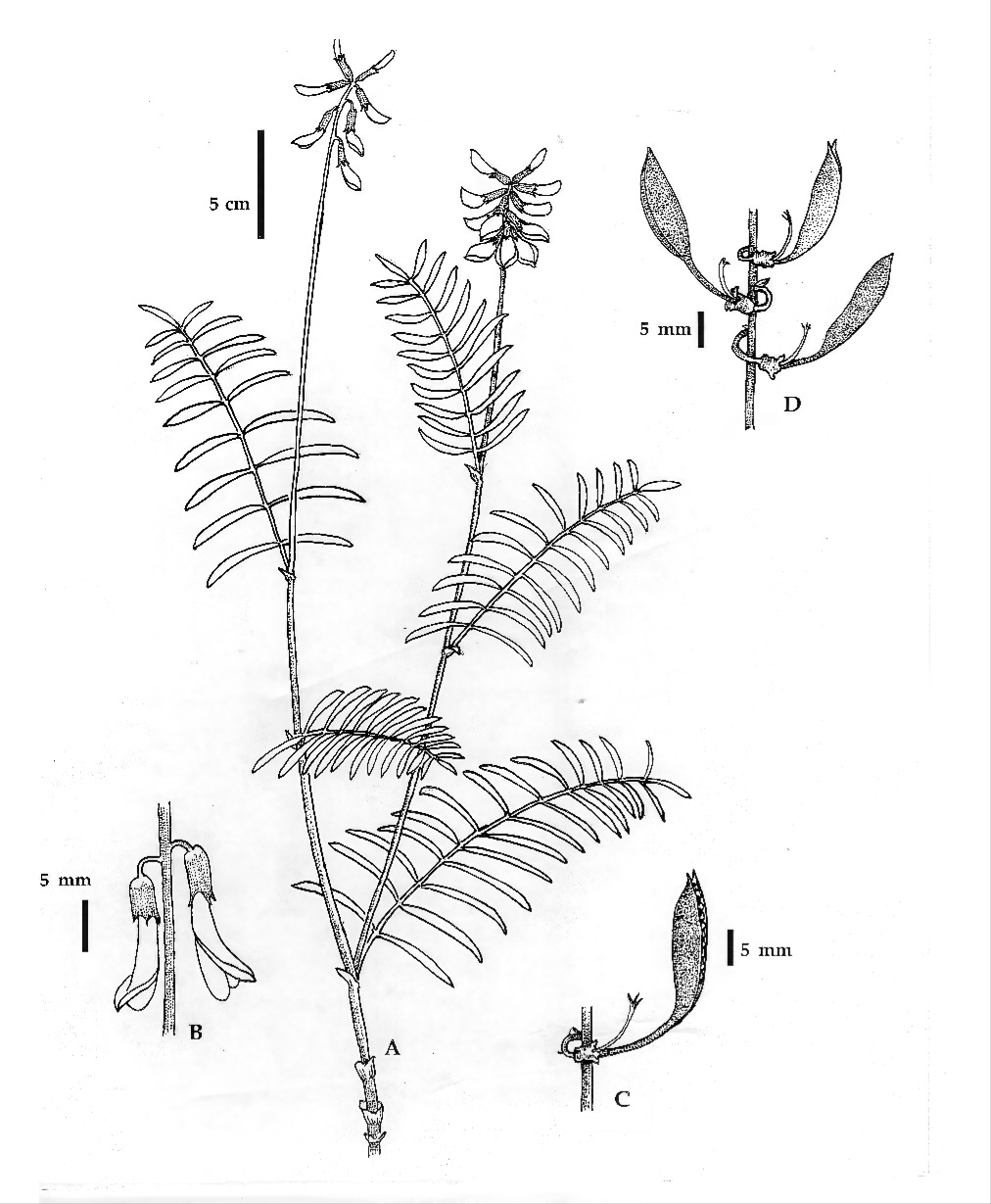
A robust perennial herb, 3-8 dm tall,with 1-6 sparsely leafy, ascending to erect, stems, which are purplish at the base. Plants are ashy-gray (cinereous) and white-hairy (strigose) throughout. Flowers are yellow. There are 9-15 leaflets per leaf. Seed pods are glabrous, laterally compressed, and borne erect or ascending; they are green at first, then turn maroon-mottled. When the plants are in fruit the pedicels become twisted, causing the pods to be erect (Spackman et al. 1997).
Look Alikes:
Astragalus tortipes is distinguished from other Astragalus species by the hyper-twisting of pedicels, which causes the pods to be erect (Spackman et al. 1997).
Phenology:
This plant flowers from April through June. The phenological cycle in A. tortipes is evidently of short duration. The entire raceme of an individual plant proceeds from flower to fruit within a two week period. By the end of June the plants have died back to the ground and only the dried stalks of the inflorescences are present (Anderson and Porter 1994).
 |
Habitat
This species is found on lower slopes of ridges and knolls, in gravels derived from a volcanic intrusion into Mancos Shale (Spackman et al. 1997). In mixed desert scrub with Atriplex confertifolia, Chrysothamnus greenei, Eriogonum clavellatum, Frankenia jamesii and Gutierrezia sarothrae (Anderson and Porter 1994).
Elevation Range:
5,450 - 5,772 feet (1,661 - 1,759 meters)
Distribution
Colorado Endemic:
Yes
Range:
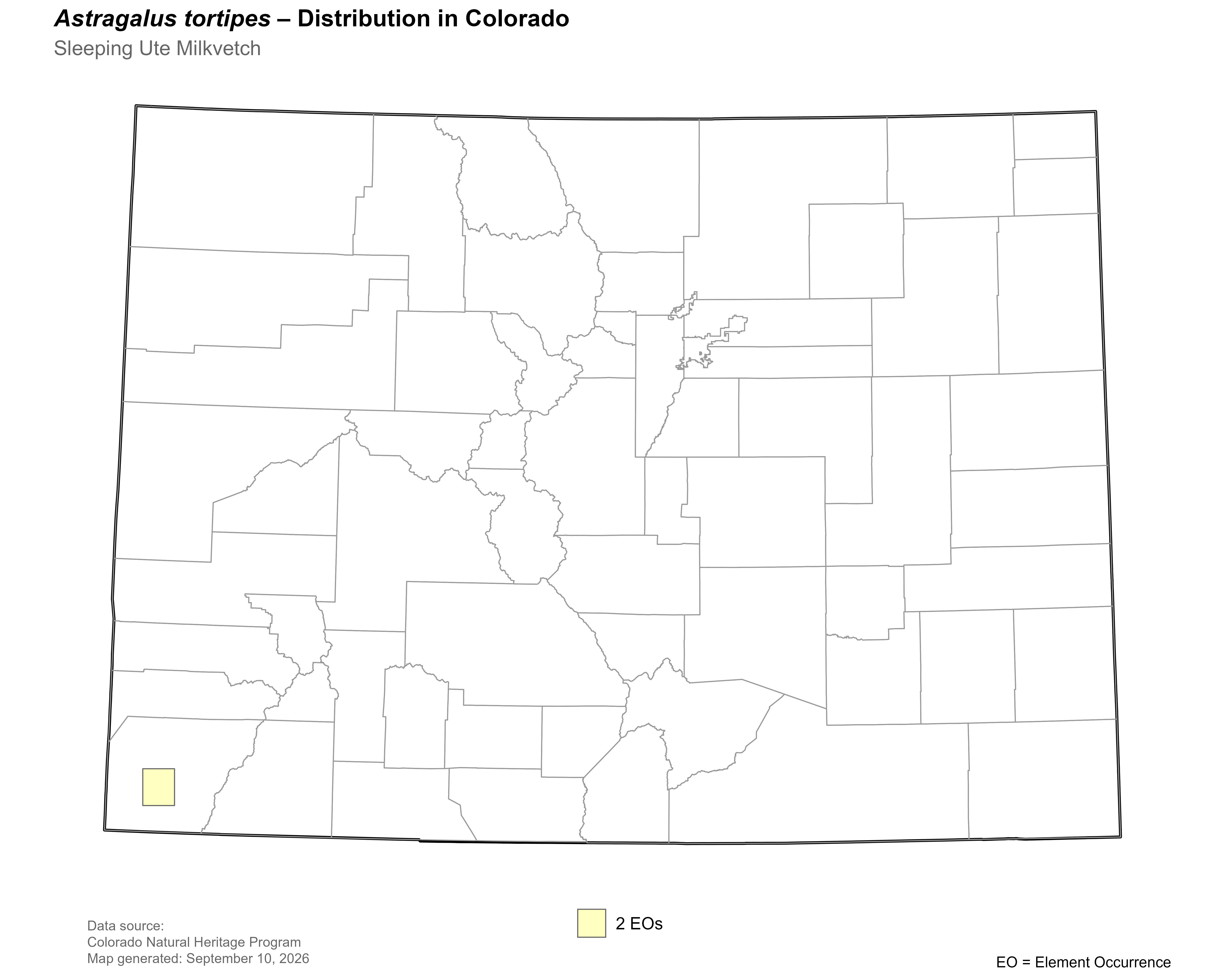
Astragalus tortipes is a Colorado endemic (Montezuma County, USA). The estimated range extent in Colorado of 8 square kilometers was calculated in GeoCAT using occurrence data provided by the Colorado Natural Heritage Program (2023).
Click on map to enlarge |
Threats and Management Issues
As of 2025, the current threats are not well documented in the occurrences and are inferred from older reports. Motorized recreation is considered to be the primary threat to the species (Rondeau et al. 2011). Off-road vehicle impacts are becoming severe in some areas. A borrow pit at the northeastern-most corner of the range on an isolated hill is currently receiving vehicle traffic but the milkvetch is reproducing around the edges (Colyer 2000). An irrigation canal carrying McPhee Reservoir water to farms runs along the northwestern edge of the milkvetch range. Three hills were cut through and some of the population was undoubtedly removed. The remaining adjacent stands of milkvetch are stable (Colyer 2000). Cattle grazing and prairie dogs do not appear to negatively impact the milkvetch (Colyer 2000). This species is considered to have low adaptive capacity and is expected to be extremely vulnerable to climate change under both RCP 4.5 and 8.5 scenarios, as assessed for the 2025 Colorado State Wildlife Action Plan (CNHP 2025).
References
- Ackerfield, J. 2012. The Flora of Colorado. Colorado State University Herbarium. 433 pp.
- Anderson, J.L., and J.M. Porter. 1994. Astragalus tortipes (Fabaceae), a new species from desert badlands in southwestern Colorado and its phylogenetic relationships within Astragalus. Systematic Botany 19(1): 116-125.
- Baskin, C.C., J.M. Baskin and E. Quarterman. 1972. Observations on the ecology of Astragalus tennesseensis. Amer. Midl. Natur. 88(1): 167-182.
- Colorado Natural Heritage Program (CNHP). 2023. Biodiversity Tracking and Conservation System (Biotics 5). Colorado Natural Heritage Program, Colorado State University, Fort Collins.
- Colorado Natural Heritage Program (CNHP). 2025. Climate Change Vulnerability Assessment of Colorado Tier 1 and Tier 2 Plant Species of Greatest Conservation Need (SCGN) for the 2025 Colorado State Wildlife Action Plan. Colorado Natural Heritage Program, Colorado State University, Fort Collins, CO.
- Colyer, M. 2000. Status Report of Sleeping Ute Milkvetch, Astragalus tortipes. Unpublished report prepared for the USFWS.
- Green, T.W. and G.E. Bohart. 1975. The pollination ecology of Astragalus cibarius and Astragalus utahensis (Leguminosae). Amer. J. Bot. 62(4): 370-386.
- Handwerk, J., L. Grunau, and S. Panjabi. 2015. Colorado Wildlife Action Plan: 2015 Rare Plant Addendum. Colorado Natural Heritage Program, Colorado State University, Fort Collins, Colorado, USA.
- Isely, D. 1998. Native and naturalized Leguminosae (Fabaceae) of the United States (exclusive of Alaska and Hawaii). Monte L. Bean Life Science Museum, Brigham Young University; MLBM Press, Provo, Utah. 1007 pp.
- Mayo, E. 2005. October-last update. Species assessment and listing priority assignment form: Astragalus tortipes. U.S. Fish and Wildlife Service, Endangered Species Program. Online. Available: http://ecos.fws.gov/docs/candforms_pdf/r6/Q3GU_P01.pdf (accessed 24 August 2007).
- Neely, B., S. Panjabi, E. Lane, P. Lewis, C. Dawson, A. Kratz, B. Kurzel, T. Hogan, J. Handwerk, S. Krishnan, J. Neale, and N. Ripley. 2009. Colorado Rare Plant Conservation Strategy, Developed by the Colorado Rare Plant conservation Initiative. The Nature Conservancy, Boulder, Colorado, 117 pp.
- Spackman, S., B. Jennings, J. Coles, C. Dawson, M. Minton, A. Kratz, and C. Spurrier. 1997. Colorado rare plant field guide. Prepared for Bureau of Land Management, U.S. Forest Service and U.S. Fish and Wildlife Service by Colorado Natural Heritage Program.
- USDA, NRCS. 2022. The PLANTS Database. National Plant Data Team, Greensboro, NC 27401-4901 USA.
- Weber, W. A. and R. C. Wittmann. 2012. Colorado Flora, Western Slope, A Field Guide to the Vascular Plants, Fourth Edition. Boulder, Colorado. 532 pp.


