


Scientific Name : Astragalus ripleyi
Author : Barneby NatureServe Explorer
Common Name : Ripley Milkvetch
 Current Research Activities
 1997 profile
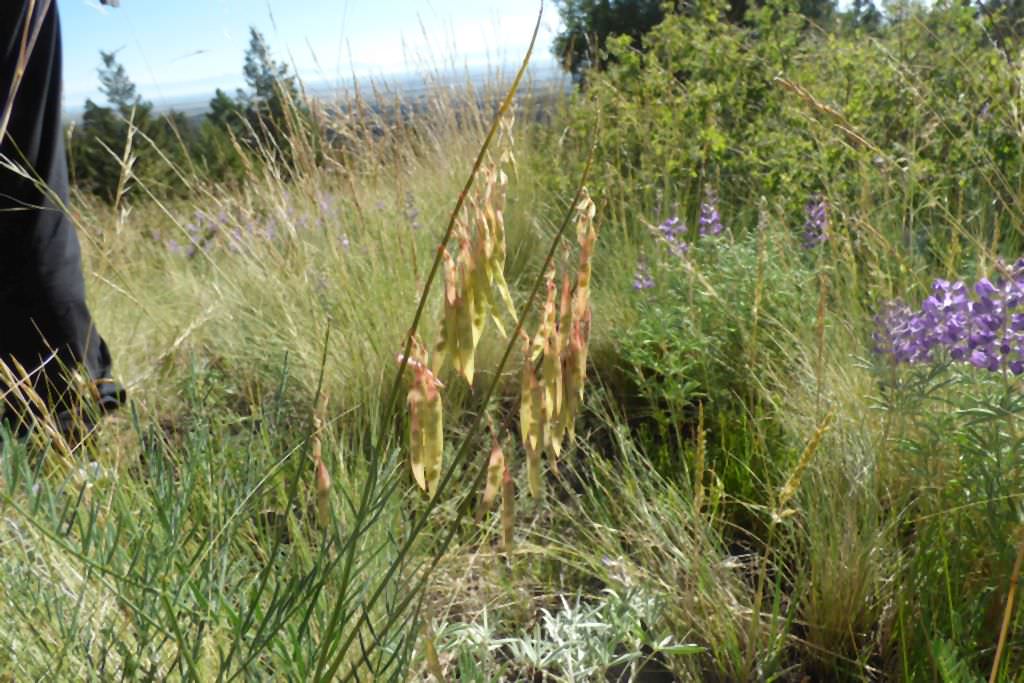
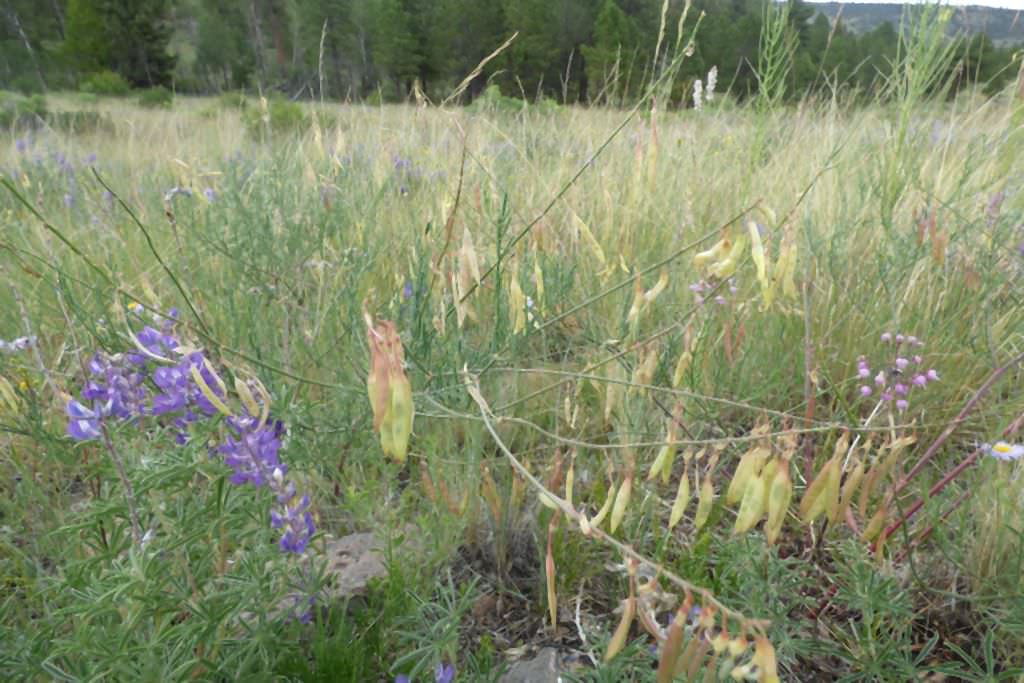


☰ Click link below for details.
Taxonomy
Fabaceae (pea family)
Ranks and Status
State Rank : S2
State Rank Reason : Astragalus ripleyi is known primarily from Conejos County with one occurrence in Archuleta County. There currently 22 occurrences, however, nearly 75% of the occurrences have not been visited for 20 or more years and current conditions and threats at those sites are not known. Widespread fire suppression, livestock grazing and invasive plant species are of management concern. Climate change is also considered a concern.
U.S. Endangered Species Act : none
Colorado Threatened and Endangered List : none
Other Statuses : BLM, SWAP Tier 2, USFS, USFS RGNF
Description and Phenology
General Description:
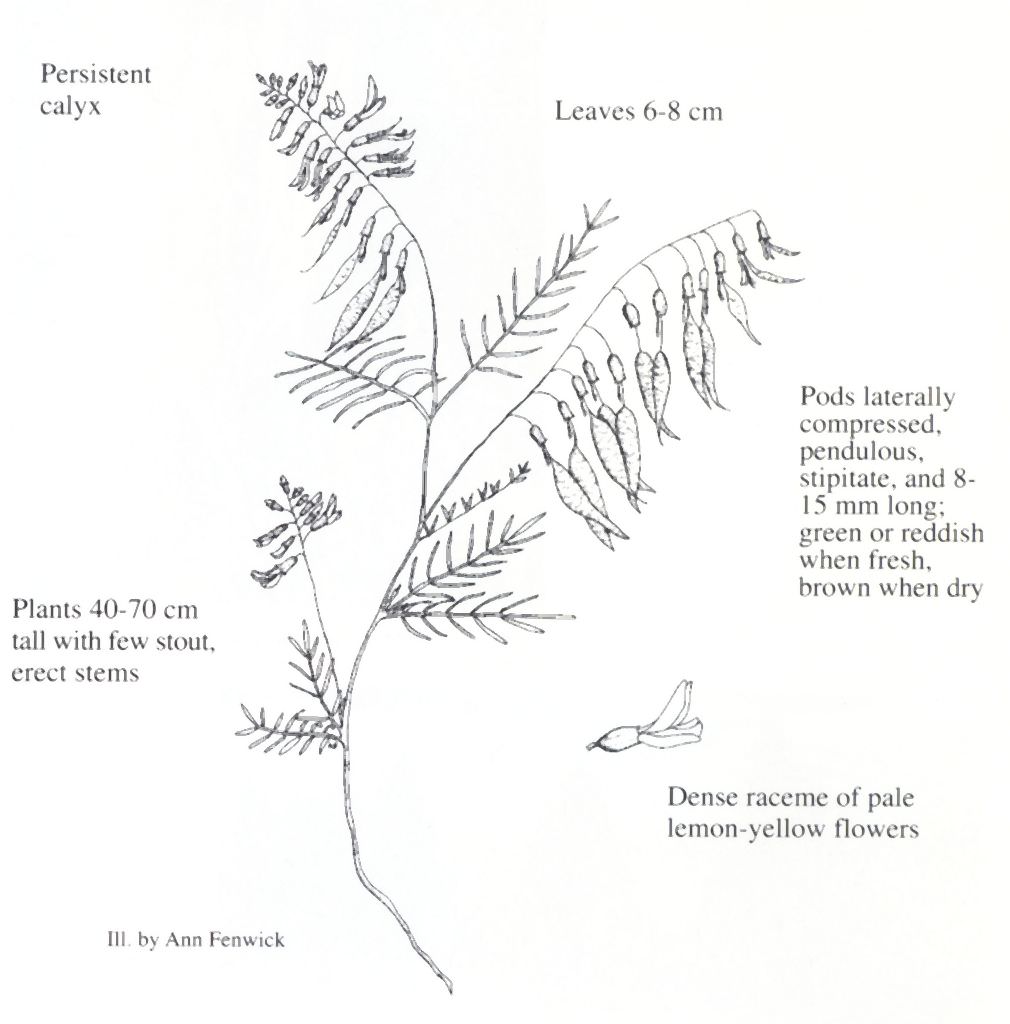
Perennial; stems 1-6 from a subterranean root-crown, stout, erect and stiffly ascending, 4-7 dm long, strigulose nearly throughout with fine, straight, appressed hairs; stipules 1-5 mm long; leaves pinnately compound, 4-9(11) cm long, commonly divaricate and incurved, shortly petioled or the uppermost subsessile; leaflets 11-21, glabrous on upper side, rather distant, opposite or scattered, linear or linear-elliptic, somewhat involute, (3)9-25(35) mm long, the terminal leaflet nearly always decurrent on the rachis; racemes loosely (5)15-45-flowered; flowers pea-like, early declined and secund; petals pale lemon-yellow, concolorous; banner recurved through approximately 35 degrees, oblanceolate or rhombic-oblanceolate, (13)14-17 mm long, 4.5-6.3 mm wide; wings 12-14 mm long, keel 10-11mm long; pod pendulous, stipitate, the slender, straight stipe 8-15 mm long, the body linear-oblong, lanceolate, or narrowly elliptic in profile, straight or a little arched downward, 2-3 cm long, 4-6 mm in diameter; seeds yellowish-brown, rugulose-punctate, dull, 3-3.5 mm long (New Mexico Rare Plant Technical Council 1999).
Look Alikes:
Astragalus lonchocarpus has cream to white flowers, 1-9 leaflets, and dorsiventrally compressed pods. Astragalus ripleyi has yellow flowers, 11-21 leaflets, and laterally compressed pods. Astragalus drummondii has dense, spreading pubescence and its pods are trigonous in cross-section (Spackman et al. 1997, New Mexico Rare Plant Technical Council 1999).
Phenology:
June-early August (Spackman et al. 1997).
 |
Habitat
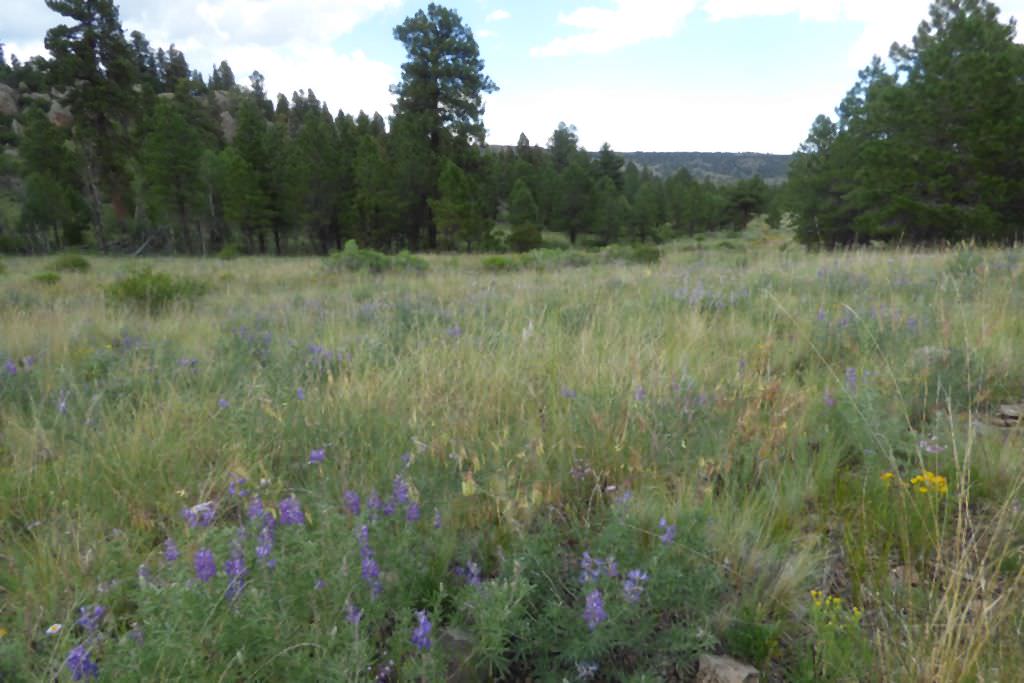
On volcanic substrates in open-canopy ponderosa pine-Arizona fescue savannah, or along the edges of mixed coniferous woodlands where Arizona fescue is dominant (Spackman et al. 1997). Also found in pinyon-juniper and sagebrush habitats. Associated species also include: Populus tremuloides, Abies concolor, Pseudotsuga menziesii, Hymenoxys richardsonii, Eriogonum racemosum, Bouteloua gracilis, Astragalus drummondii, Bromus porteri, Potentilla hippiana, Heliomeris multiflora, Lupinus sericeus, Bromus ciliatus, Elymus trachycaulus, E. elymoides, Opuntia polyacantha, Artemisia frigida, Ribes cereum, Geranium viscosissimum, Penstemon griffinii, Heterotheca villosa, Achnatherm hymenoides, Pericome caudata, Chrysothamnus vaseyi, C. viscidiflorus, C. greenei, C. parryi, Muhlenbergia montana, Koeleria macrantha, Symphoricarpos rotundifolius, Potentilla hippiana, Orthocarpus purpureoalbus, Artemisia carruthii, Erigeron speciosus, Picradenia richardsonii, Symphoricarpos oreophilus, Krascheninnikovia lanata.
click on image to enlarge
 |
Elevation Range:
8,133 - 10,177 feet (2,479 - 3,102 meters)
Distribution
Colorado Endemic:
No
Range:
All but one of the Colorado occurrences of Astragalus ripleyi are in Conejos County; there is one occurrence in neighboring Archuleta County, Colorado, USA. Estimated range extent in Colorado of 1951 square kilometers was calculated in GeoCAT using occurrence data provided by the Colorado Natural Heritage Program (2023). This species can also be found in New Mexico, USA.
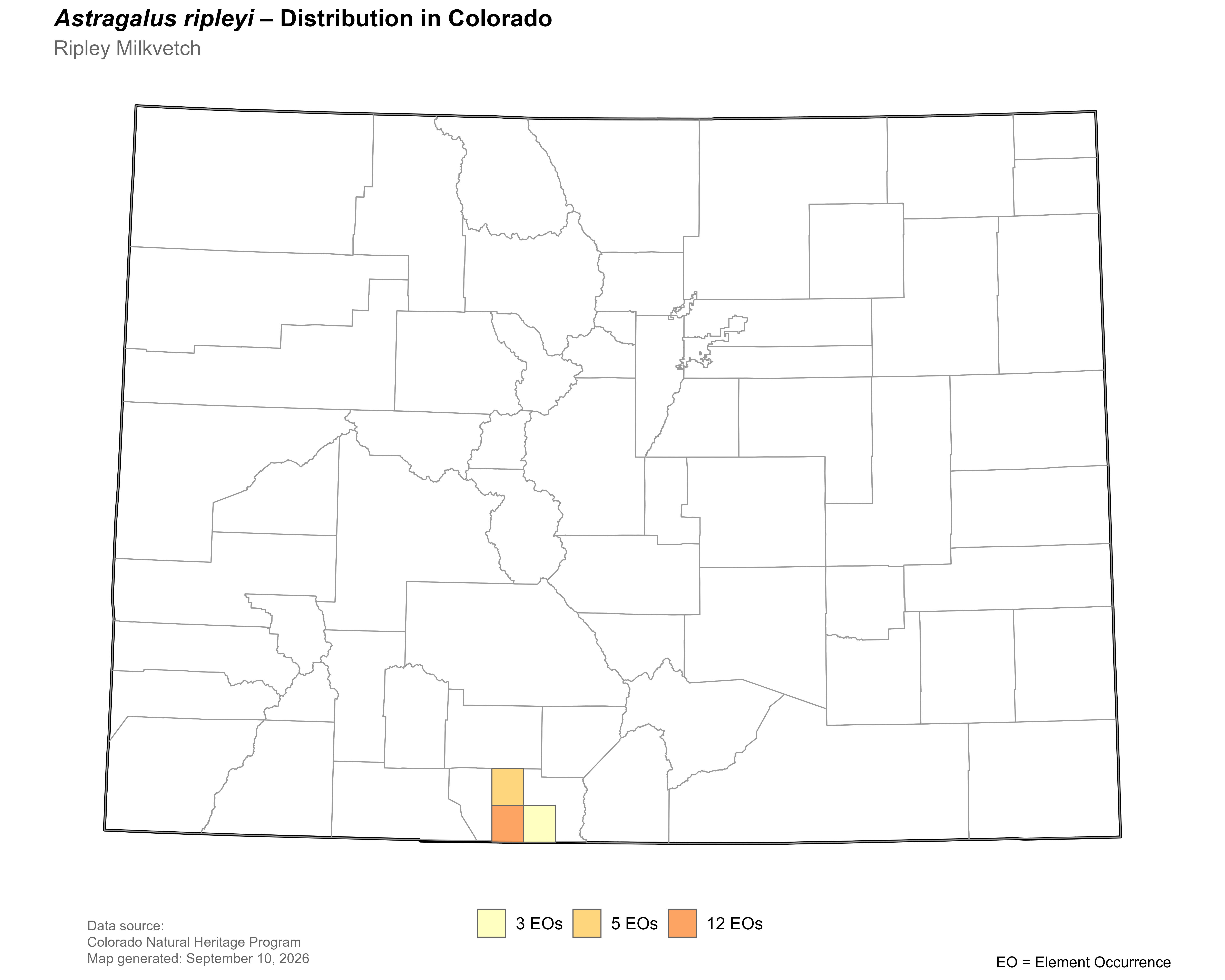
Click on map to enlarge |
Threats and Management Issues
As of 2022, 71% of the occurrences are found in habitat with minimal to low levels of landscape disturbance, and the remainder in areas with moderate to high levels of landscape disturbance (CNHP 2021). Widespread fire suppression is thought to be the main threat to the species and its habitat; in addition it is considered extremely palatable to livestock, with grazing by domestic sheep a considerable threat (BLM 2023). Additionally, invasion of non-native plant species are threats to some of the populations. Long term drought is occurring throughout the range of this species. This species is considered to have low adaptive capacity and is expected to be moderately to extremely vulnerable to climate change under both RCP 4.5 and 8.5 scenarios, as assessed for the 2025 Colorado State Wildlife Action Plan (CNHP 2025).
References
- Ackerfield, J. 2022. Flora of Colorado. Second Edition. Bot. Misc. 60. BRIT Press, Fort Worth Botanic Garden/Botanical Research Institute of Texas, U.S.A. 861 pp.
- Barneby, R. C. 1964. Atlas of North American Astragalus. Memoirs of New York Botanical Garden, vol. 13. New York Botanical Garden, Bronx, NY.
- Bureau of Land Management (BLM). 2023. BLM Colorado Sensitive Species List (signed by state director on August 24). https://www.blm.gov/sites/default/files/docs/2023-09/BLM%20CO%20Sensitive%20Species%20List_2023.pdf
- Burt, J. 1999. Effects of grazing and fire on Astragalus ripleyi Barneby; summary of 1998 field work. Unpublished document. March 15. Submitted to U.S.D.A. Forest Service, Rio Grande National Forest, Colorado, USA.
- Colorado Native Plant Society. 1989. Rare plants of Colorado. Rocky Mountain Nature Association, Colorado Native Plant Society, Estes Park, Colorado. 73 pp.
- Colorado Native Plant Society. 1997. Rare Plants of Colorado, second edition. Falcon Press Publ., Helena, MT.
- Colorado Natural Heritage Program (CNHP). 2023. Biodiversity Tracking and Conservation System (Biotics 5). Colorado Natural Heritage Program, Colorado State University, Fort Collins.
- Colorado Natural Heritage Program (CNHP). 2025. Climate Change Vulnerability Assessment of Colorado Tier 1 and Tier 2 Plant Species of Greatest Conservation Need (SCGN) for the 2025 Colorado State Wildlife Action Plan. Colorado Natural Heritage Program, Colorado State University, Fort Collins.
- Isely, D. 1998. Native and naturalized Leguminosae (Fabaceae) of the United States (exclusive of Alaska and Hawaii). Monte L. Bean Life Science Museum, Brigham Young University; MLBM Press, Provo, Utah. 1007 pp.
- Ladyman, J.A.R. (2003, December 16). Astragalus ripleyi Barneby (Ripley's milkvetch): a technical conservation assessment. [Online]. USDA Forest Service, Rocky Mountain Region. Available: http:// www.fs.fed.us/r2/projects/scp/assessments/astragalusripleyi.pdf [March 2004].
- Naumann, T.S. 1990 a. Status report for Astragalus ripleyi Unpublished report prepared for the Colorado Natural Areas Program, Denver, CO.
- New Mexico Rare Plant Technical Council. 1999. New Mexico Rare Plants. Albuquerque, NM: New Mexico Rare Plants Home Page. https://nmrareplants.unm.edu (Latest update: 14 Jun 2023).
- Spackman, S., B. Jennings, J. Coles, C. Dawson, M. Minton, A. Kratz, and C. Spurrier. 1997. Colorado rare plant field guide. Prepared for Bureau of Land Management, U.S. Forest Service and U.S. Fish and Wildlife Service by Colorado Natural Heritage Program.
- USDA, NRCS. 2013. The PLANTS Database. National Plant Data Team, Greensboro, NC 27401-4901 USA.
- Weber, W. A. and R. C. Wittmann. 2012. Colorado Flora, Eastern Slope, A Field Guide to the Vascular Plants, Fourth Edition. Boulder, Colorado. 555 pp.


