

Scientific Name : Astragalus osterhoutii
Author : M.E. Jones NatureServe Explorer
Common Name : Kremmling Osterhout Milkvetch
 Current Research Activities
 1997 profile


☰ Click link below for details.
Taxonomy
Fabaceae (pea family)
Ranks and Status
State Rank : S1
State Rank Reason : Astragalus osterhoutii is endemic to small area in Grand County, Colorado, USA. It is known from seven occurrences within five localized areas. Threats to A. osterhoutii include include disturbance and habitat loss from off highway vehicles, road maintenance (including snow plowing, and weed control), competition from non-native weedy species, black blister beetle herbivory, transmission line maintenance, and herbivory and trampling by cattle and wildlife. It is considered extremely vulnerable to climate change.
U.S. Endangered Species Act : ESA Endangered
Colorado Threatened and Endangered List : none
Other Statuses : SWAP Tier 1
Description and Phenology
General Description:
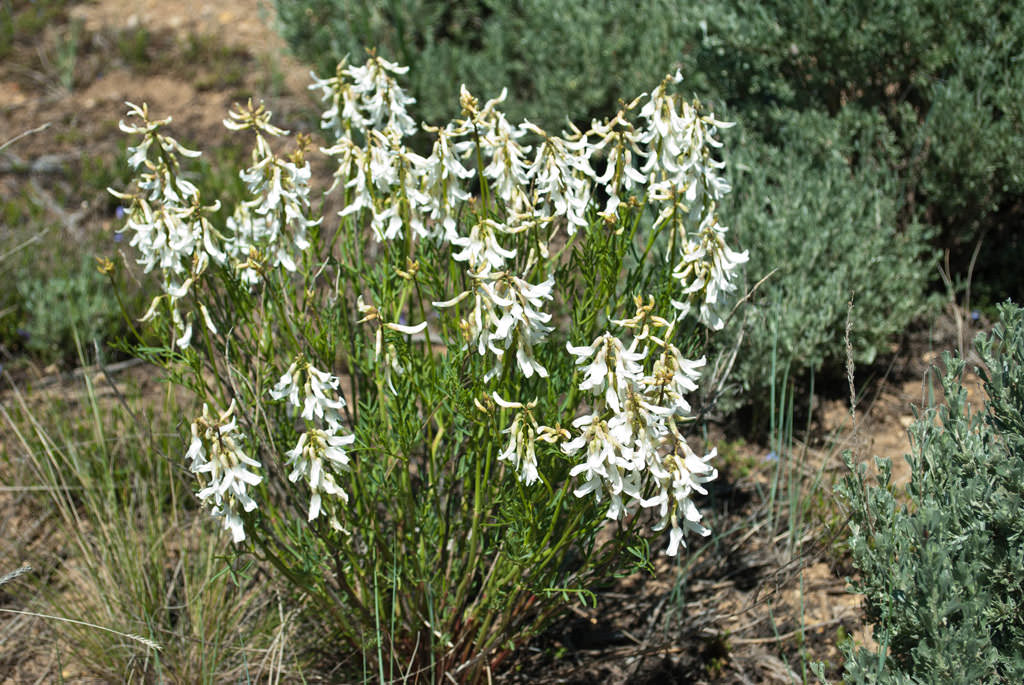
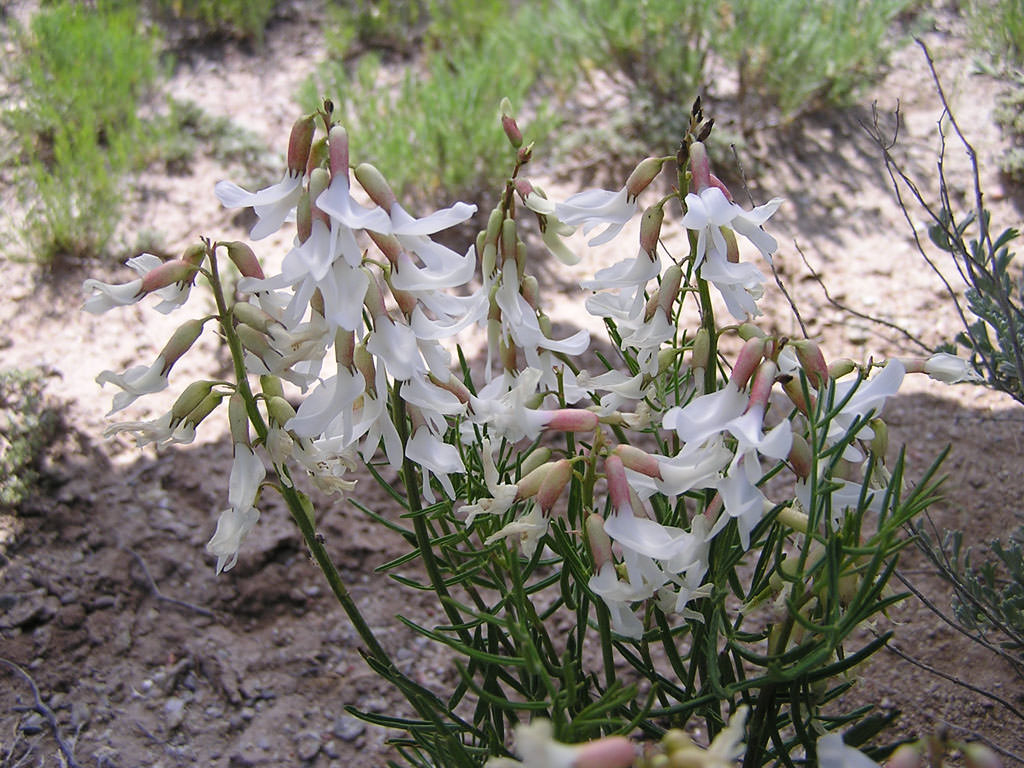
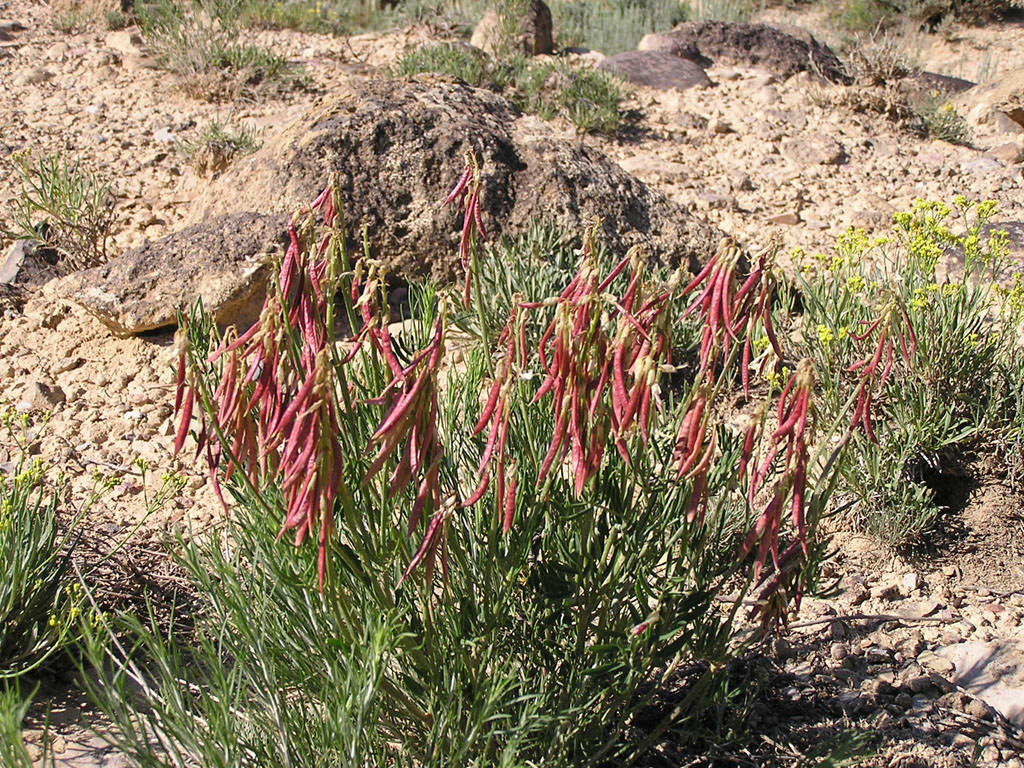
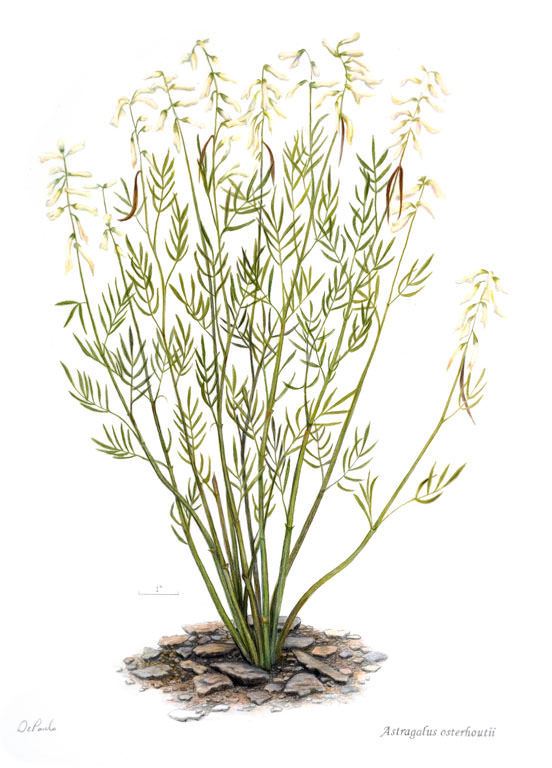
Relatively tall (up to 100 cm) herbaceous, perennial plants with numerous bright green stems and white to cream colored flowers. Flowers are about 2 cm long and clustered toward the end of branches. Leaflets are 15-30 mm long, subsessile, and linear-oblong or lanceolate. Pods are 40 mm in length, stipitate, and strongly laterally compressed. Pods are bright green and turn red/maroon as they mature (Spackman et al. 1997).
Look Alikes:
Astragalus osterhoutii can be distinguished from look alikes by its height, flower color, and pod length. A. duchesnensis is 15-40 cm in height, has pink-purple flowers with white wing tips, and pods 20-35 mm in length, and is not known to occur in Grand county. A. convallarius is 20-50 cm in height, has greenish white flowers which are often tinged with purple, and pods 10-12 cm in length. Also similar to A. scopulorum which has oblong to elliptic leaflets. A. bisulcatus occurs in the same habitat but has bicolored flowers.
Phenology:
Flowers June to August (Colorado Natural Heritage Program 2012).
 |
Habitat
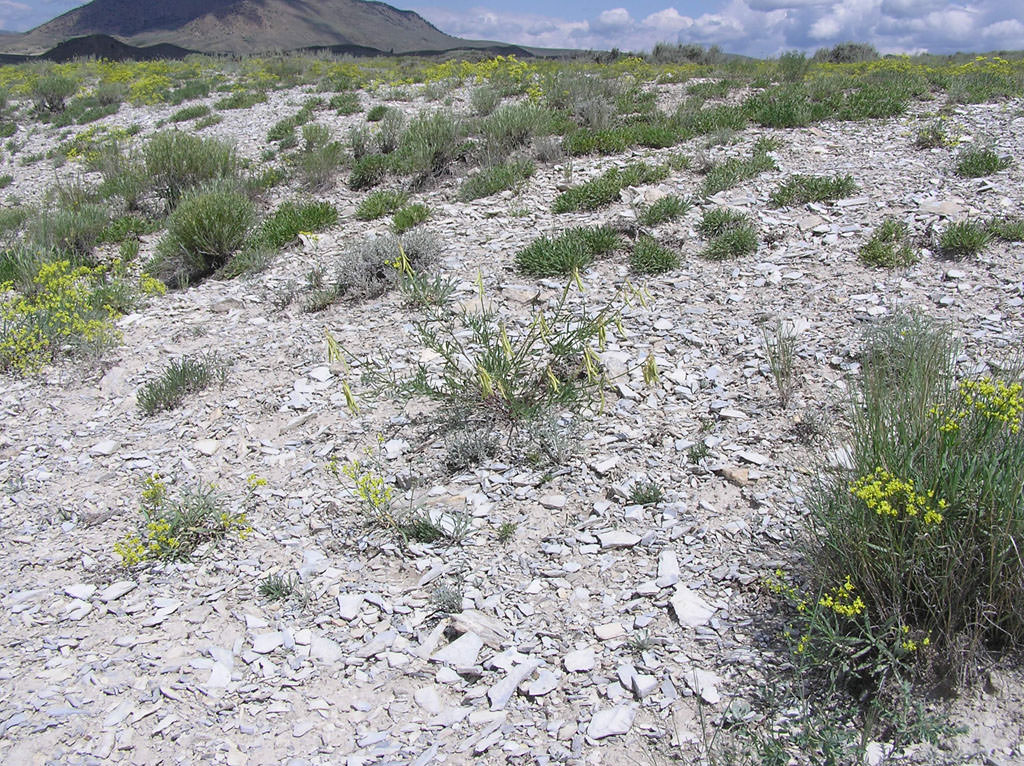
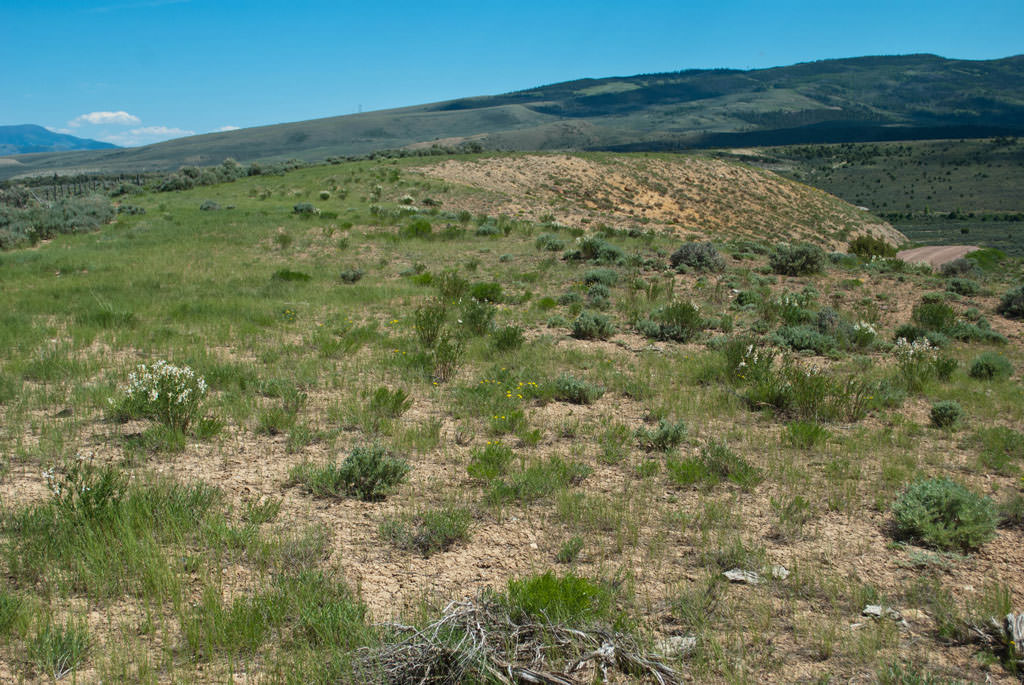
Highly seleniferous, grayish-brown clay soils derived from shales of the Niobrara, Pierre, and Troublesome formations. On moderate slopes, sometimes found growing up through sagebrush (Spackman et al. 1997). Associated species include: Artemisia tridentata, Chrysothamnus viscidiflorus, Gutierrezia sarothrae, Eurotia lanata, Phlox hoodii, Eriogonum brevicaule, and Agropyron smithii.
click on image to enlarge
 |
 |
Elevation Range:
7,367 - 8,013 feet (2,245 - 2,442 meters)
Distribution
Colorado Endemic:
Yes
Range:
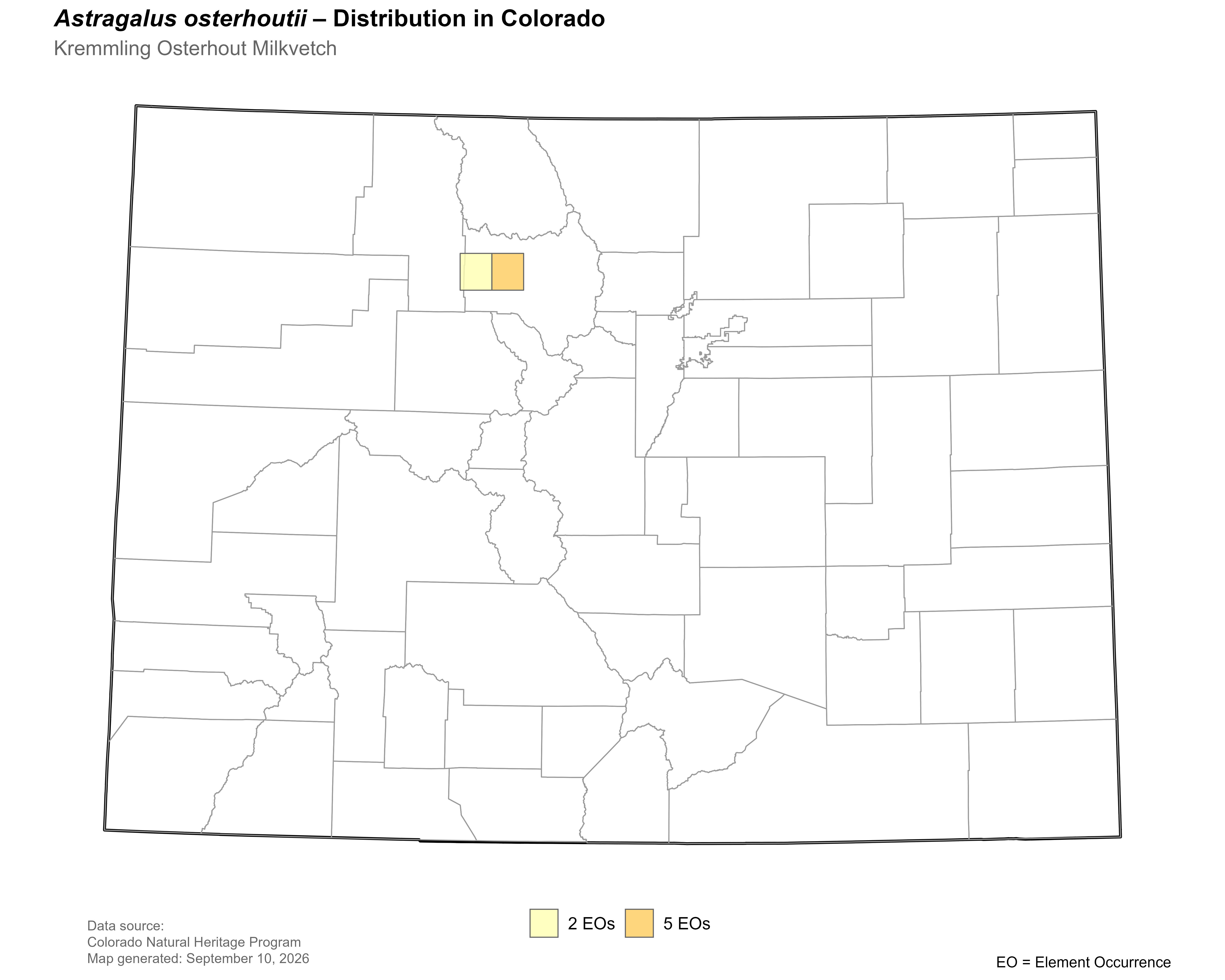
Astragalus osterhoutii is endemic to Grand County, Colorado, USA. The estimated range extent in Colorado of 111 square kilometers was calculated in GeoCAT using occurrence data provided by the Colorado Natural Heritage Program (2022).
Click on map to enlarge |
Threats and Management Issues
Threats to Astragalus osterhoutii include disturbance and habitat loss from off highway vehicles (OHVs) traveling off designated routes, road maintenance (including snow plowing and weed control), competition from non-native weedy species, black blister beetle (Epicauta puncticollis or E. pensylvanica) herbivory, transmission line maintenance, and herbivory and trampling by cattle and wildlife (Dawson 1999, Panjabi and Neely 2011, Taliga 2012, CNHP 2022). Dam maintenance at Wolford Mountain Reservoir is also of concern. This species is considered to have low adaptive capacity and is expected to be extremely vulnerable to climate change under both RCP 4.5 and 8.5 scenarios, as assessed for the 2025 Colorado State Wildlife Action Plan (CNHP 2025).
References
- Ackerfield, J. 2012. The Flora of Colorado. Colorado State University Herbarium. 433 pp.
- Barneby, R. C. 1964. Atlas of North American Astragalus. Memoirs of New York Botanical Garden, vol. 13. New York Botanical Garden, Bronx, NY.
- Baskin, C.C., J.M. Baskin and E. Quarterman. 1972. Observations on the ecology of Astragalus tennesseensis. Amer. Midl. Natur. 88(1): 167-182.
- Colorado Native Plant Society. 1989. Rare plants of Colorado. Rocky Mountain Nature Association, Colorado Native Plant Society, Estes Park, Colorado. 73 pp.
- Colorado Natural Heritage Program (CNHP). 2022. Biodiversity Tracking and Conservation System (Biotics 5). Colorado Natural Heritage Program, Colorado State University, Fort Collins.
- Colorado Natural Heritage Program (CNHP). 2025. Climate Change Vulnerability Assessment of Colorado Tier 1 and Tier 2 Plant Species of Greatest Conservation Need (SCGN) for the 2025 Colorado State Wildlife Action Plan. Colorado Natural Heritage Program, Colorado State University, Fort Collins.
- Dawson, C.A. 1999. The autecology of Astragalus osterhoutii Jones. Dissertation. University of Denver, Denver, CO.
- Elliott, B. A., S. Spackman Panjabi, B. Kurzel, B. Neely, R. Rondeau, M. Ewing. 2009. Recommended Best Management Practices for Plants of Concern. Practices developed to reduce the impacts of oil and gas development activities to plants of concern. Unpublished report prepared by the Rare Plant Conservation Initiative for the National Fish and Wildlife Foundation.
- Green, T.W. and G.E. Bohart. 1975. The pollination ecology of Astragalus cibarius and Astragalus utahensis (Leguminosae). Amer. J. Bot. 62(4): 370-386.
- Krening, P. 2021. Osterhout’s milkvetch (Astragalus osterhoutii) population trend monitoring summary-2021. Prepared for the Colorado State Office - Bureau of Land Management, U.S. Department of the Interior.
- Krening, P. 2022. Osterhout’s milkvetch (Astragalus osterhoutii) Population Trend Monitoring Summary-2022. Prepared for the Colorado State Office - Bureau of Land Management, U.S. Department of the Interior.
- Neely, B., S. Panjabi, E. Lane, P. Lewis, C. Dawson, A. Kratz, B. Kurzel, T. Hogan, J. Handwerk, S. Krishnan, J. Neale, and N. Ripley. 2009. Colorado Rare Plant Conservation Strategy, Developed by the Colorado Rare Plant conservation Initiative. The Nature Conservancy, Boulder, Colorado, 117 pp.
- O'Kane, S. L. 1988. Colorado's Rare Flora. Great Basin Naturalist. 48(4):434-484.
- Panjabi, S. and B. Neely. 2011. Middle Park Conservation Action Plan, 2011 Update. Prepared by The Nature Conservancy and the Colorado Natural Heritage Program. Unpublished report prepared for the National Fish and Wildlife Foundation.
- Rocky Mountain Society of Botanical Artists. 2009. RARE Imperiled Plants of Colorado, a traveling art exhibition. Exhibition catalogue developed by the Denver Botanic Gardens and Steamboat Art Museum.
- Spackman, S., B. Jennings, J. Coles, C. Dawson, M. Minton, A. Kratz, and C. Spurrier. 1997. Colorado rare plant field guide. Prepared for Bureau of Land Management, U.S. Forest Service and U.S. Fish and Wildlife Service by Colorado Natural Heritage Program.
- Taliga, C.E. 2012. Plant Guide for Kremmling milkvetch (Astragalus osterhoutii). USDA-Natural Resources Conservation Service, Colorado State Office. Denver, CO 80225-0426.
- U.S. Fish and Wildlife Service (USFWS). 1988. Proposal to determine Astragalus osterhoutii and Penstemon penlandii to be endangered species. Federal Register 53(128): 25181-25185.
- USDA, NRCS. 2022. The PLANTS Database. National Plant Data Team, Greensboro, NC 27401-4901 USA.
- Weber, W. A. and R. C. Wittmann. 2012. Colorado Flora, Western Slope, A Field Guide to the Vascular Plants, Fourth Edition. Boulder, Colorado. 532 pp.