

Scientific Name : Astragalus cronquistii
Author : Barneby NatureServe Explorer
Common Name : Cronquist's Milkvetch
 Current Research Activities
 1997 profile


☰ Click link below for details.
Taxonomy
Fabaceae (pea family)
Ranks and Status
State Rank : S1
State Rank Reason : Astragalus cronquistii is known from extreme SW Colorado and SE Utah, USA. There are 11 occurrences in Colorado, but their current status is unknown and they are considered historical observations. Potential threats to the species include off-road vehicle use, competition from invasive plant species, and oil and gas development. Astragalus cronquistii is also considered to be vulnerable to climate change.
U.S. Endangered Species Act : none
Colorado Threatened and Endangered List : none
Other Statuses : SWAP SGIN
Description and Phenology
General Description:
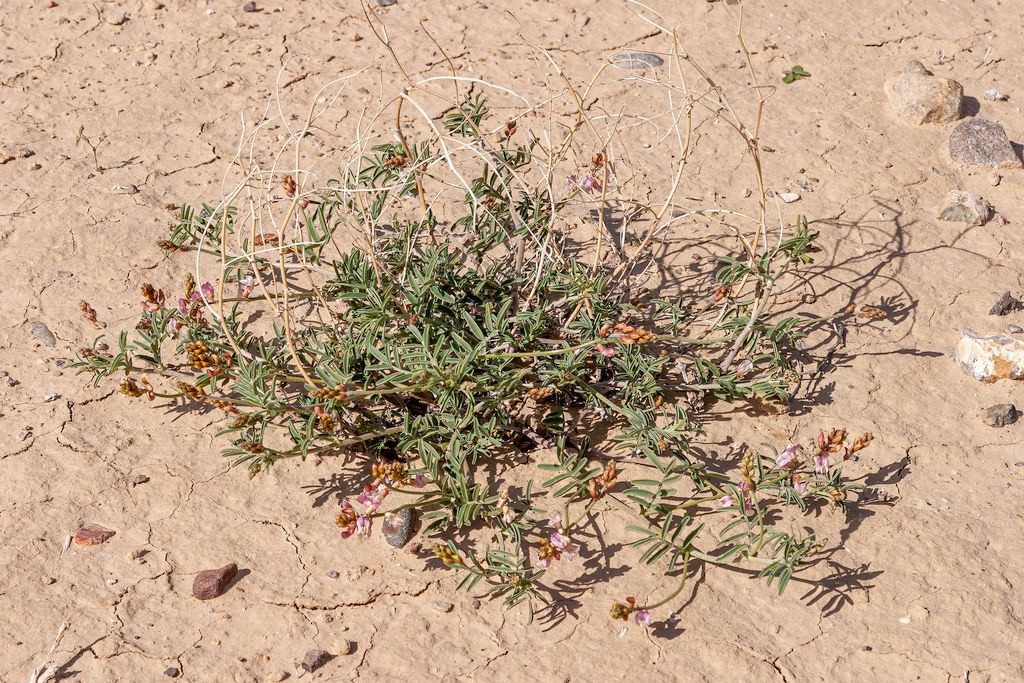
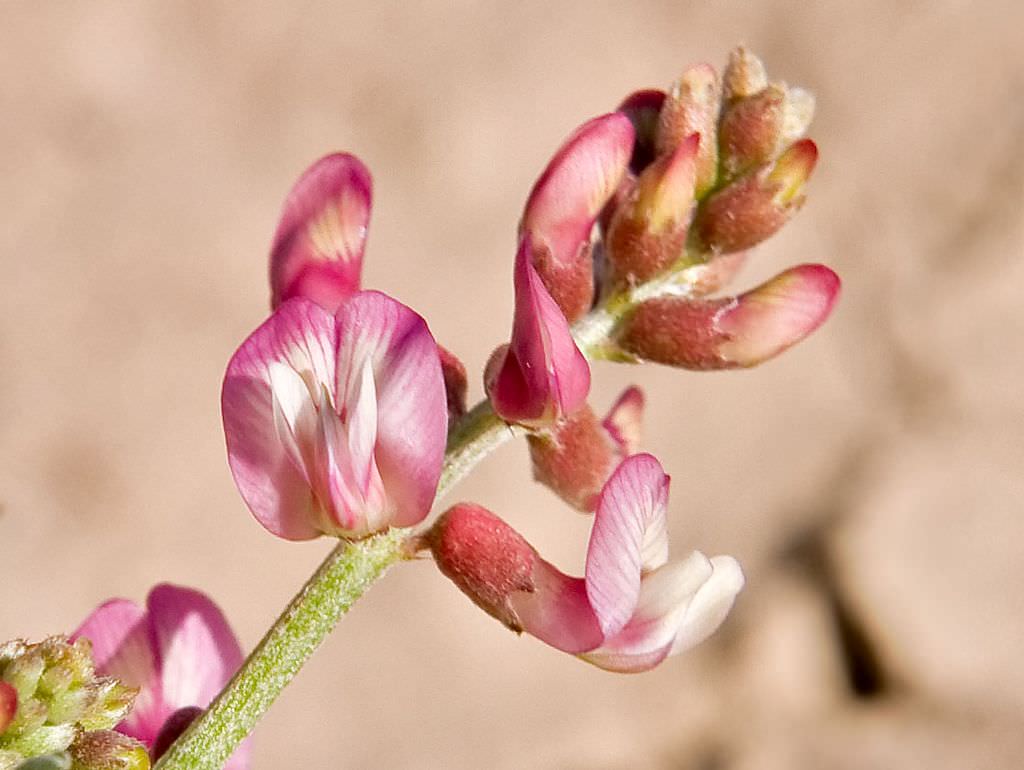
Decumbent perennials, rhizomatous, 2-4 dm; leaves pinnately compoind with 7-13 leaflets; leaflets elliptic to narrowly oblong, 6-20 mm long, glabrate above; inflorescence exserted, 5-20 flowered; calyx tube 3-4 mm long, lobes 0.5-1 mm long; flowers red-purple or reddish, the banner 8-9 mm long; legumes oblong to oblong-oblanceolate, 3-angled, 2-3 cm x 3.5-5 mm, stigulose (Ackerfield 2015).
Look Alikes:
A. cronquistii resembles A. fucatus when in flower. However, the former has sheathing, not truly connate lower stipules. When in fruit, A. cronquistii has an obtusely trigonous, bilocular pod while A. fucatus has a unilocular, mottled pod (Cronquist 1989).
Phenology:
Flowering in late April and May; fruiting in May.
Habitat
Astragalus cronquistii occurs on low, sandy and gravelly ridges, on red sandstone (Barneby 1964). It grows on Mancos shale and on substrates derived from the Morrison Formation. Associated with Chrysothamnus and Atriplex, Oryzopsis hymenoides, Hilaria jamesii, Cymopterus fendleri, Astragalus missouriensis and Sporobolus cryptandrus (O'Kane 1985). Also found on clay hills, and also associated with Atriplex confertifolia, A. cuneata, A. confertifola,Streptanthella longirostris, Phacelia crenulata, Gutierrezia sarothrae, Sporobolus airoides, and Mentzelia pumila.
Elevation Range:
4,807 - 5,941 feet (1,465 - 1,811 meters)
Distribution
Colorado Endemic:
No
Range:
Astragalus cronquistii is known from Montezuma County in Colorado, USA. Estimated range extent in Colorado of 264 square kilometers was calculated in GeoCAT using occurrence data provided by the Colorado Natural Heritage Program (2023). This taxon is also known from the Navajo Nation and Utah.
Threats and Management Issues
The primary threat at this time is considered to be roads (Rondeau et al. 2011). It is not known if all of the occurrences are or are not threatened by these activities. In Colorado, Astragalus cronquistii is known from Ute Mountain Ute tribal lands in the southwestern corner of Montezuma County. The area has high potential for oil and gas development (BLM 1998) but is not in an area of active drilling (USDI USGS 2003). Populations are threatened by road construction and gas exploration and by an impending system of canals (O'Kane 1988). May also be threatened by off-road vehicle use and weed invasion. This species is considered to be extremely vulnerable to climate change (Handwerk et al. 2015).
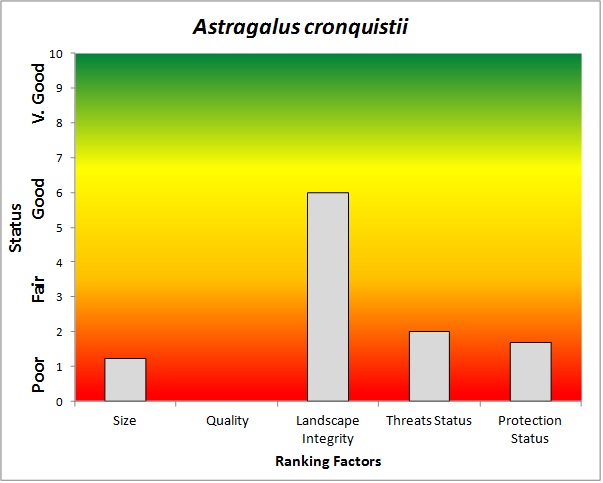
Summary results of an analysis of the status of Astragalus cronquistii based on several ranking factors. This species was concluded to be Under Conserved. From Rondeau et al. 2011. |
References
- Ackerfield, J. 2015. Flora of Colorado. BRIT Press, Botanical Research Institute of Texas, Fort Worth, TX. 818 pp.
- Barneby, R. C. 1964. Atlas of North American Astragalus. Memoirs of New York Botanical Garden, vol. 13. New York Botanical Garden, Bronx, NY.
- Barneby, R.C. 1989. Fabales. In A. Cronquist, A.H. Holmgren, N.H. Holmgren, J.L. Reveal, and P.K. Holmgren (eds.). Intermountain flora: Vascular plants of the Intermountain West, U.S.A. Vol. 3, Part B. New York Botanical Garden, Bronx. 279 pp.
- Colorado Native Plant Society. 1989. Rare plants of Colorado. Rocky Mountain Nature Association, Colorado Native Plant Society, Estes Park, Colorado. 73 pp.
- Colorado Natural Heritage Program (CNHP). 2023. Biodiversity Tracking and Conservation System (Biotics 5). Colorado Natural Heritage Program, Colorado State University, Fort Collins.
- Cronquist A. 1989. Intermountain Flora Vascular Plants of the Intermountain West, USA. Vol. 3, Part B. New York Botanical Garden, Bronx, NY.
- Handwerk, J., L. Grunau, and S. Panjabi. 2015. Colorado Wildlife Action Plan: 2015 Rare Plant Addendum. Colorado Natural Heritage Program, Colorado State University, Fort Collins, Colorado, USA.
- Neely, B., S. Panjabi, E. Lane, P. Lewis, C. Dawson, A. Kratz, B. Kurzel, T. Hogan, J. Handwerk, S. Krishnan, J. Neale, and N. Ripley. 2009. Colorado Rare Plant Conservation Strategy, Developed by the Colorado Rare Plant conservation Initiative. The Nature Conservancy, Boulder, Colorado, 117 pp.
- O'Kane, S. L. 1988. Colorado's Rare Flora. Great Basin Naturalist. 48(4):434-484.
- Rondeau, R., K. Decker, J. Handwerk, J. Siemers, L. Grunau, and C. Pague. 2011. The state of Colorado's biodiversity 2011. Prepared for The Nature Conservancy. Colorado Natural Heritage Program, Colorado State University, Fort Collins, Colorado.
- Spackman, S., B. Jennings, J. Coles, C. Dawson, M. Minton, A. Kratz, and C. Spurrier. 1997. Colorado rare plant field guide. Prepared for Bureau of Land Management, U.S. Forest Service and U.S. Fish and Wildlife Service by Colorado Natural Heritage Program.
- USDA, NRCS. 2022. The PLANTS Database. National Plant Data Team, Greensboro, NC 27401-4901 USA.
- Weber, W. A. and R. C. Wittmann. 2012. Colorado Flora, Western Slope, A Field Guide to the Vascular Plants, Fourth Edition. Boulder, Colorado. 532 pp.
- Welsh, S.L., N.D. Atwood, S. Goodrich, and L.C. Higgins (eds.) 1993. A Utah flora. 2nd edition. Brigham Young Univ., Provo, Utah. 986 pp.