


Scientific Name : Aquilegia saximontana
Author : Rydb. NatureServe Explorer
Common Name : Rocky Mountain Columbine
 Current Research Activities
 1997 profile
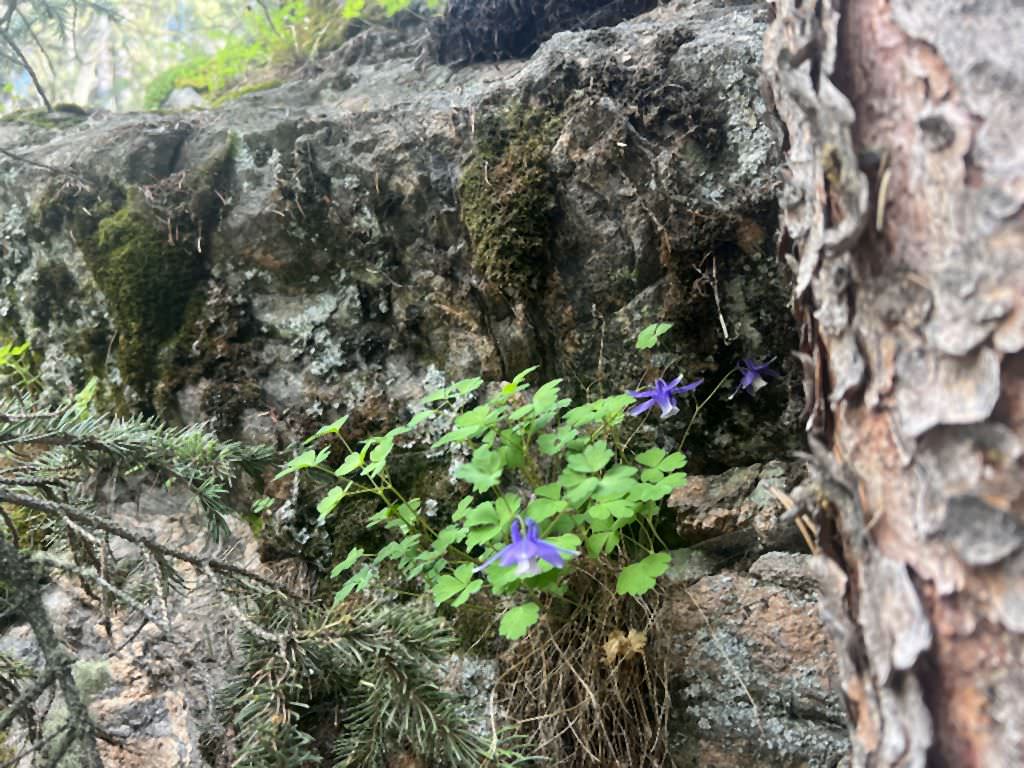
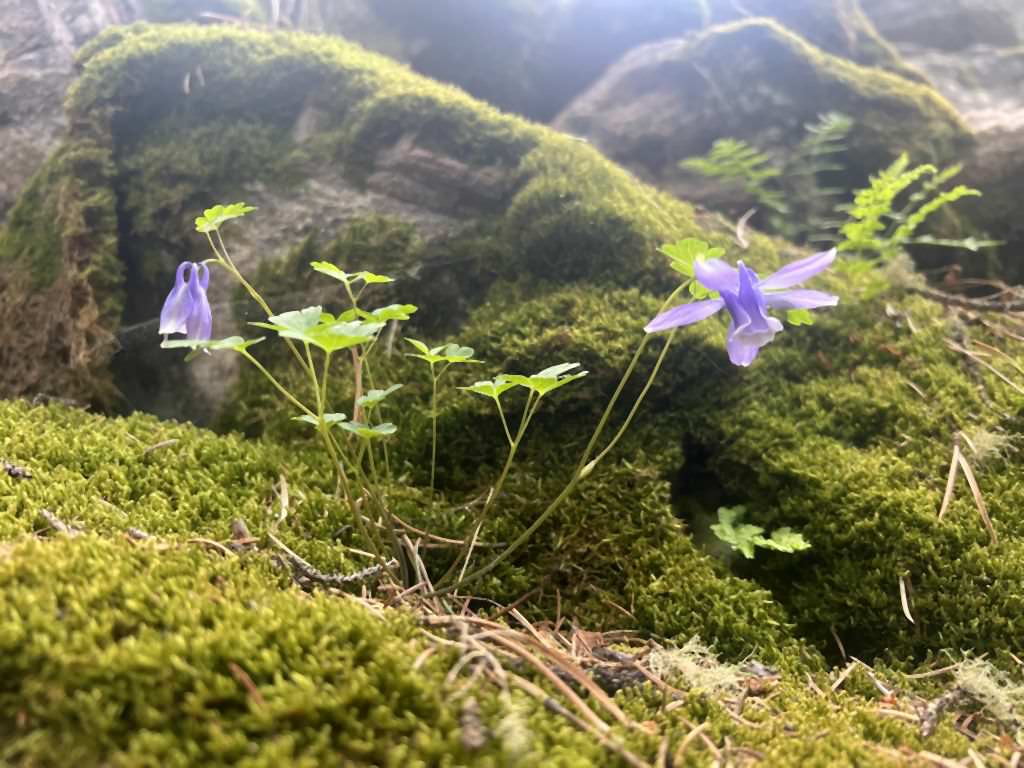
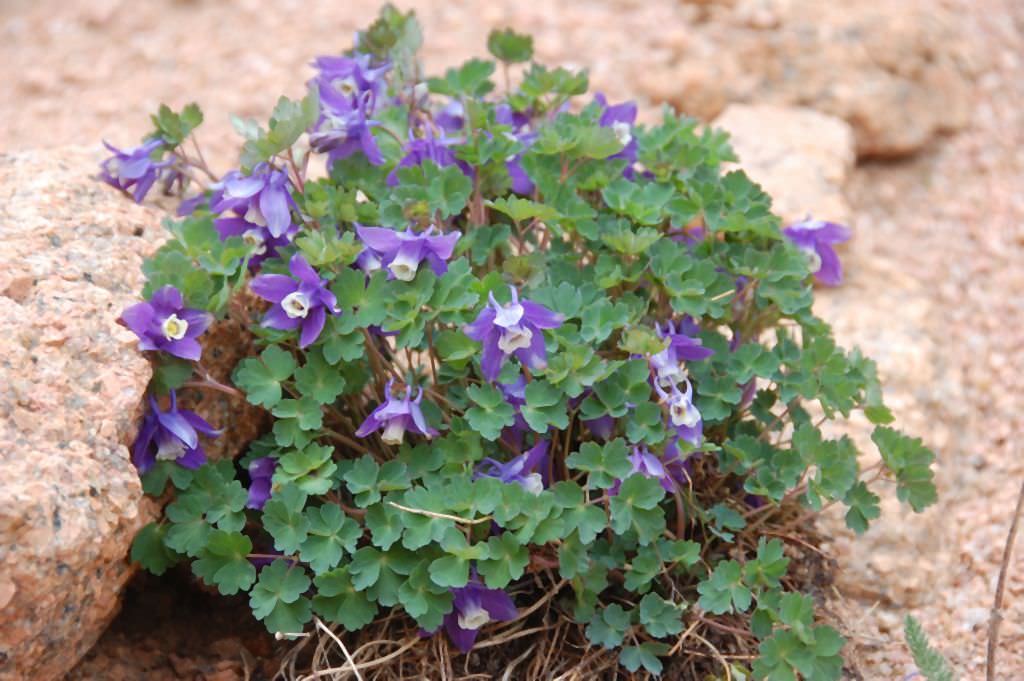


☰ Click link below for details.
Taxonomy
Ranunculaceae (buttercup family)
Ranks and Status
State Rank : S3
State Rank Reason : Aquilegia saximontana is known from less than 100 occurrences in subalpine and alpine areas in north central Colorado, USA. Threats include non-motorized recreation, roadside disturbance, and the effects of climate change.
U.S. Endangered Species Act : none
Colorado Threatened and Endangered List : none
Other Statuses : SWAP Tier 2
Description and Phenology
General Description:
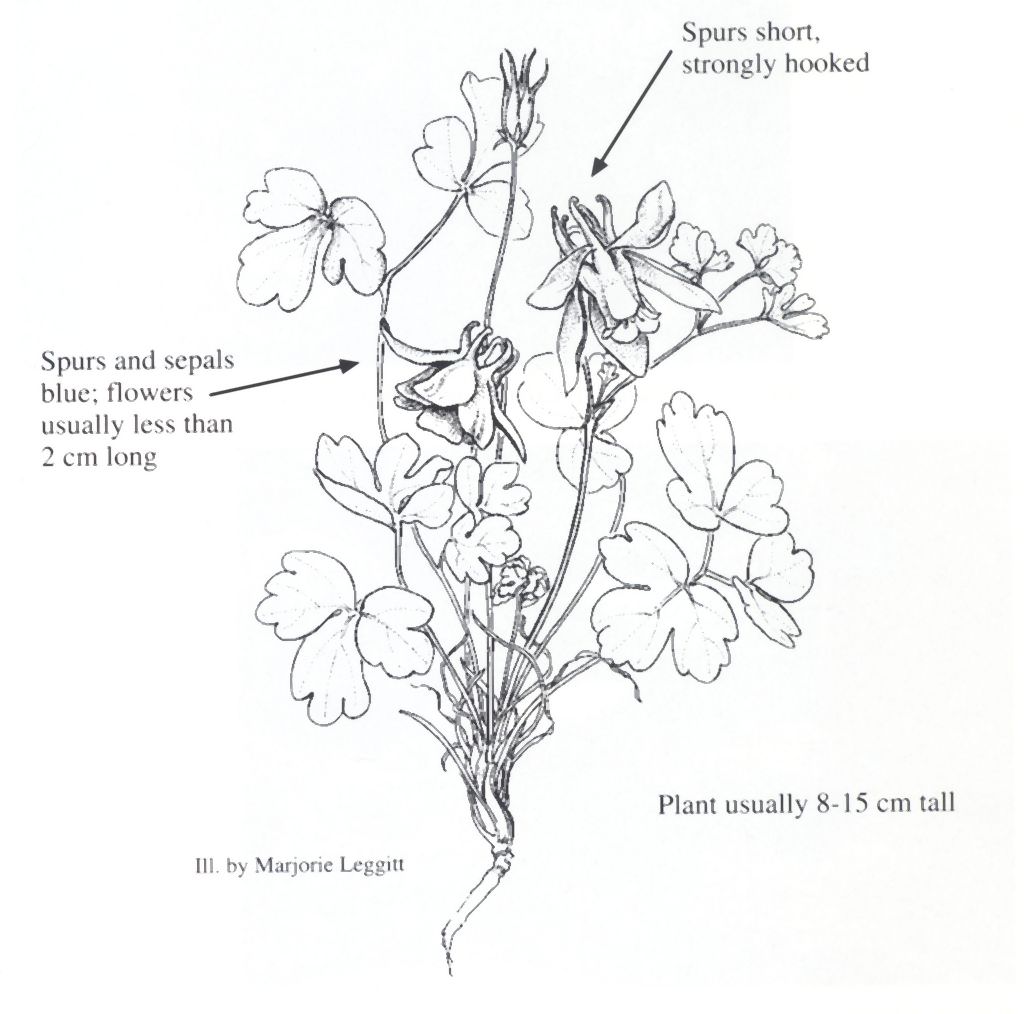
Stems 5-25 cm. Basal leaves 1-2Ã-ternately compound, 5-25 cm, no longer than stems; leaflets green adaxially, 7-22 mm, not viscid; primary petiolules 7-40 mm (leaflets usually crowded), glabrous. Flowers nodding; sepals divergent from floral axis, blue, oblong-ovate, 9-18 Ã 5-8 mm, apex obtuse to acute; petals: spurs blue, hooked, 3-9 mm, stout, evenly tapered from base, blades yellowish, oblong or spatulate, 7-10 Ã 3-5 mm; stamens 5-8 mm. Follicles 7-10 mm; beak 3-5 mm. (Flora of North America 1993+).
Look Alikes:
Aquilegia coerulea has long straight spurs and larger flowers (Spackman et al. 1997). Aquilegia saximontana spurs are hooked.
Phenology:
Flowers and fruits in July and August (Ackerfield 2022).
 |
Habitat
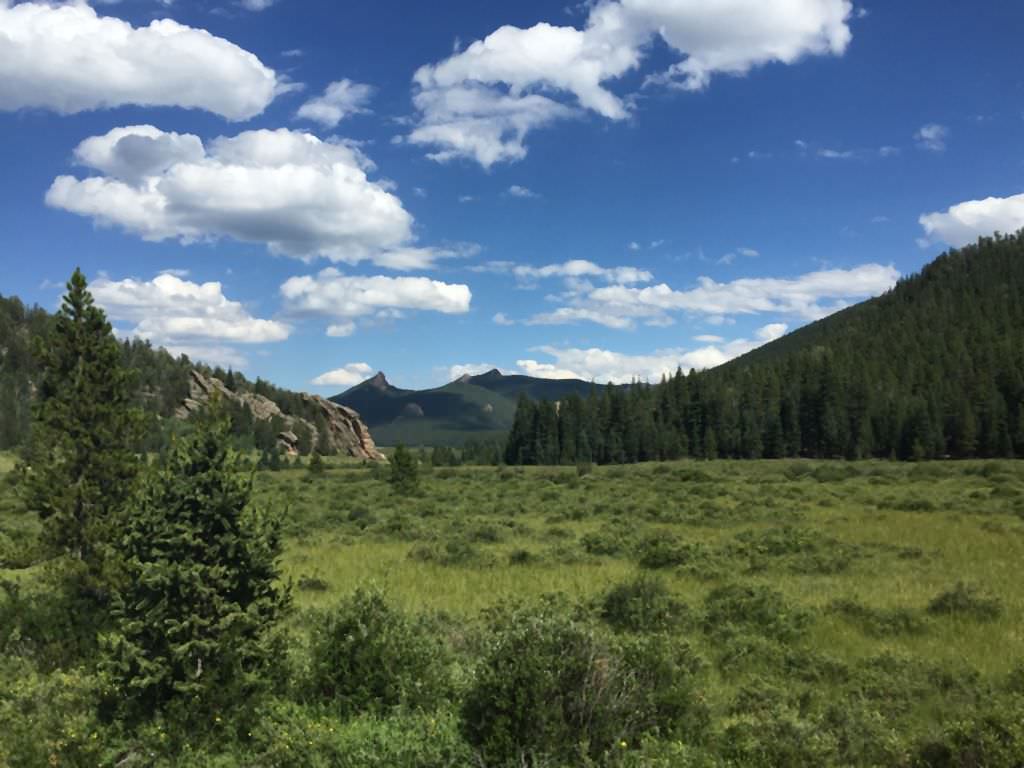
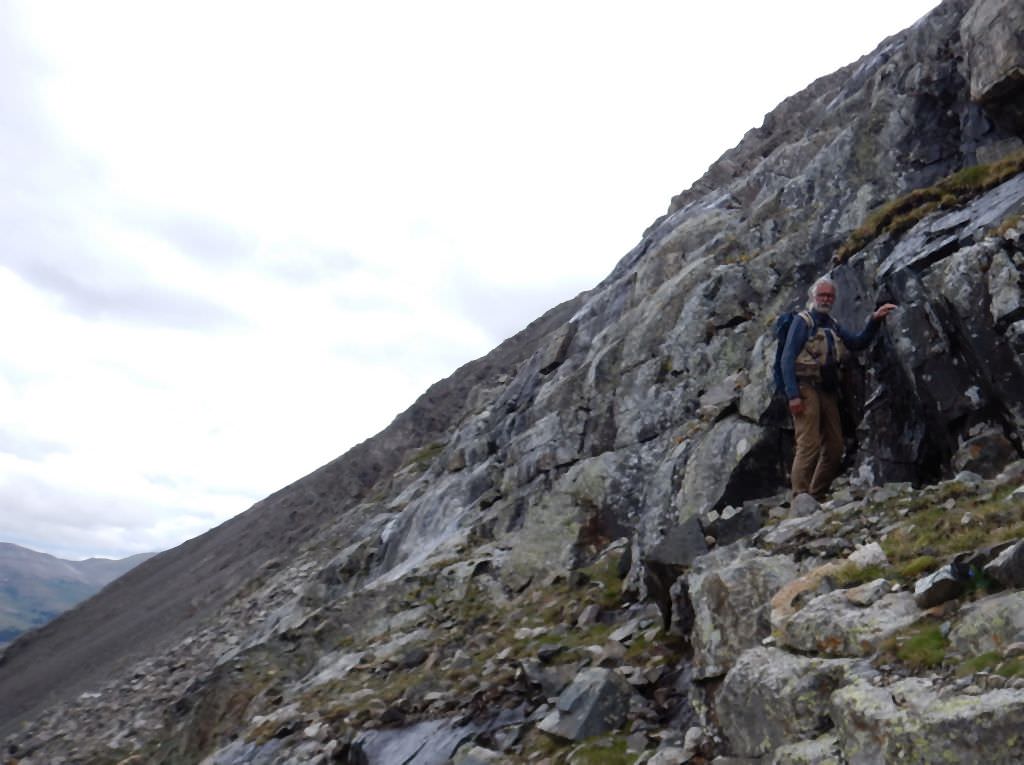
Cliffs and rocky slopes, subalpine and alpine (Flora of North America 1993+). Sparsely vegetated areas with: Pinus flexilis, Populus tremmuloides, Pseudotsuga menziesii, Cirsium scopulorum, Saxifraga austromontana, Oreoxis humilis, Chamerion angustifolium, Paronychia pulvinata, Maianthemum stellatum, Senecio eremophilus, Solidago multiradiata, Eriogonum flavum ssp. chloranthum, Phacelia sericea, Phlox condensata, Polemonium viscossum, Cystopteris fragilis, Carex elynoides, Draba breweri var. cana, Claytonia megarhiza.
click on image to enlarge
 |
 |
Elevation Range:
7,621 - 14,255 feet (2,323 - 4,345 meters)
Distribution
Colorado Endemic:
Yes
Range:
Aquilegia saximontana is known from northern and central Colorado in the following counties: Boulder, Clear Creek, El Paso, Garfield, Gilpin, Jackson, Jefferson, Larimer, Park, Summit, and Teller. Estimated range extent in Colorado of 19,315 square kilometers was calculated in GeoCAT using occurrence data provided by the Colorado Natural Heritage Program (2026).
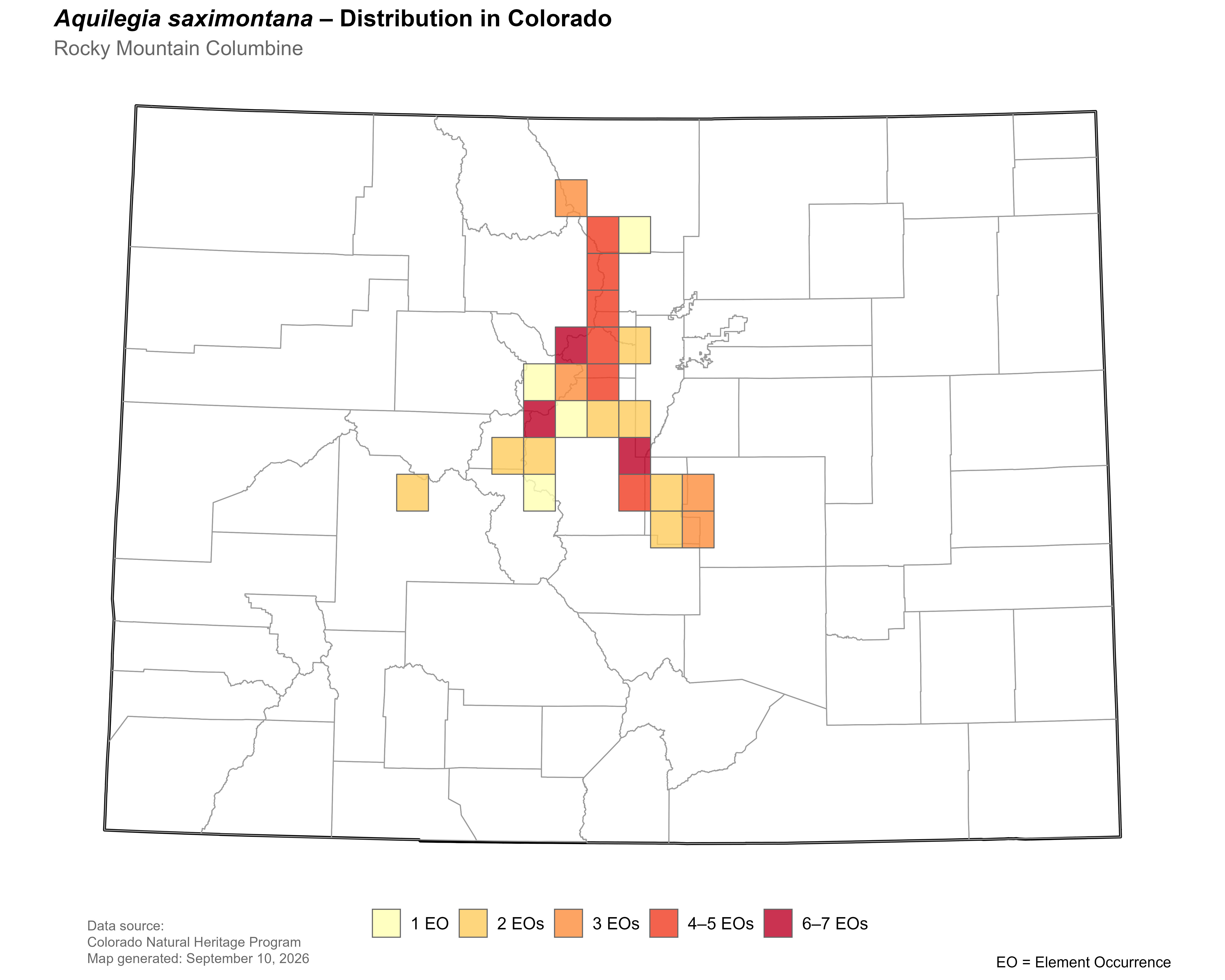
Click on map to enlarge |
Threats and Management Issues
Threats are only reported from one third of the occurrences; and from those the primary threat is from non-motorized recreation including hiking and rock climbing. Five occurrences are along roadsides where maintenance activity (plowing/paving/widening) and erosion are a concern. Several sites are in areas with evidence of past mining activity and may be potentially threatened by future use of mining claims. Changes in temperature and precipitation throughout the species range may also cause deleterious effects. This species is considered to have low adaptive capacity and is expected to be moderately vulnerable to climate change under both RCP 4.5 and 8.5 scenarios, as assessed for the 2025 Colorado State Wildlife Action Plan (CNHP 2025).
References
- Ackerfield, Jennifer. 2022. Flora of Colorado. Second Edition. Bot. Misc. 60. BRIT Press, Fort Worth Botanic Garden/Botanical Research Institute of Texas, U.S.A. 861 pp.
- Colorado Natural Heritage Program (CNHP). 2022. Biodiversity Tracking and Conservation System (Biotics 5). Colorado Natural Heritage Program, Colorado State University, Fort Collins.
- Colorado Natural Heritage Program (CNHP). 2025. Climate Change Vulnerability Assessment of Colorado Tier 1 and Tier 2 Plant Species of Greatest Conservation Need (SCGN) for the 2025 Colorado State Wildlife Action Plan. Colorado Natural Heritage Program, Colorado State University, Fort Collins, CO.
- Flora of North America Editorial Committee, ed. (FNA). 1993+. Flora of North America North of Mexico. Oxford Univ. Press, New York, Oxford.
- Spackman, S., B. Jennings, J. Coles, C. Dawson, M. Minton, A. Kratz, and C. Spurrier. 1997. Colorado rare plant field guide. Prepared for Bureau of Land Management, U.S. Forest Service and U.S. Fish and Wildlife Service by Colorado Natural Heritage Program.
Biotics Export Date : 2026-09-16