


Scientific Name : Aliciella sedifolia
Author : (Brandeg.) J.M. Porter NatureServe Explorer
Common Name : Stonecrop Gilia
 Current Research Activities
☰ Click link below for details.
Taxonomy
Polemoniaceae (phlox family)
=Gilia sedifolia
Ranks and Status
State Rank : S1
State Rank Reason : Aliciella sedifolia is an extremely rare endemic of the alpine zone of the San Juan Mountains of Colorado, USA. It had been thought to be extinct but was rediscovered near the original site in 1995 and at the type location in 2007. Since then 2 additional occurrences have been found. Threats to the species include livestock grazing, motorized recreation and climate change.
U.S. Endangered Species Act : none
Colorado Threatened and Endangered List : none
Other Statuses : SWAP SGIN, USFS, USFS GMUG, USFS RGNF
Description and Phenology
General Description:
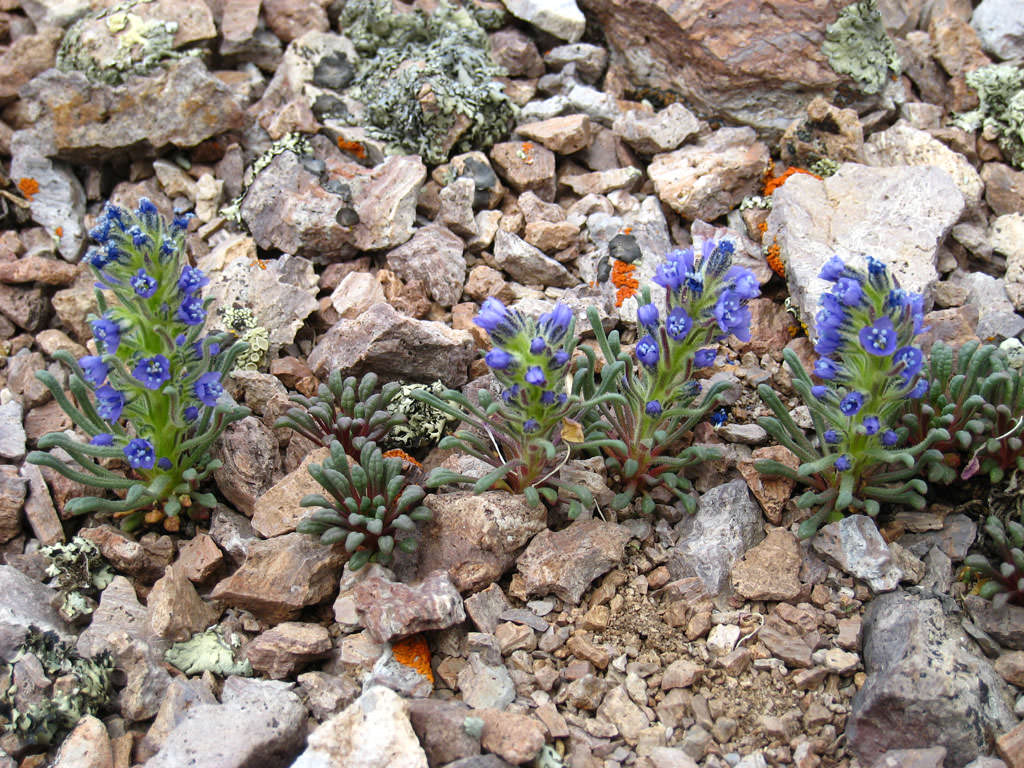
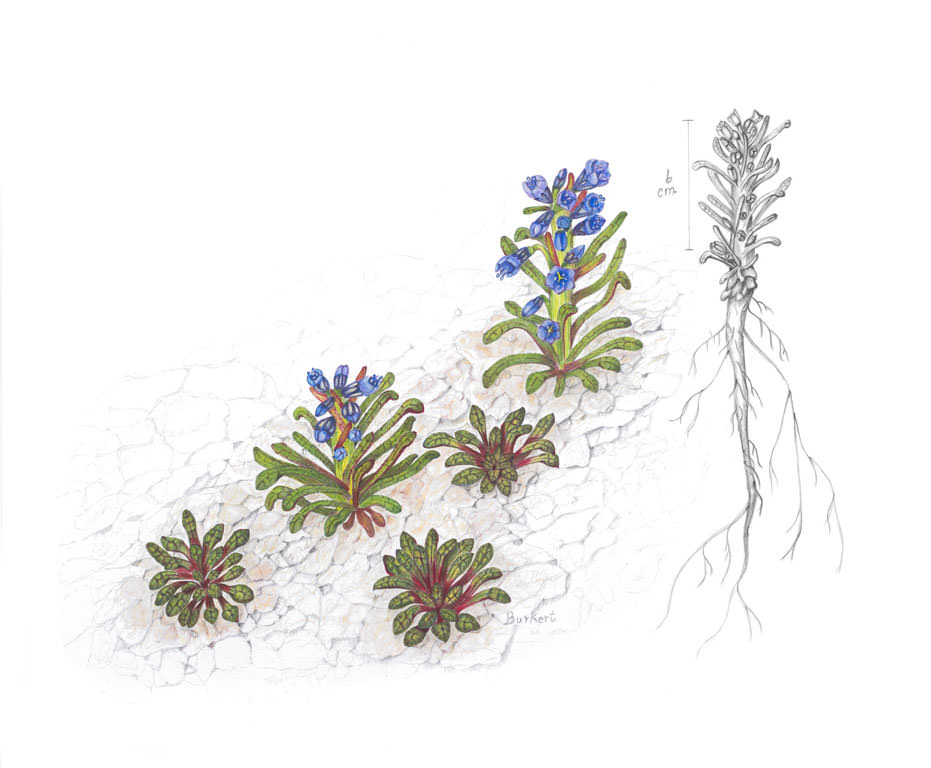
A small-statured, taprooted herb with a basal rosette of leaves. Leaves are linear, entire, terete, and suculent. Flowers are are dark purple-blue and have corollas with lobes longer than the tube. Flowers are borne in a somewhat spikelike, few-flowered cluster. Like many other members of this family it appears to be a biennial, or possibly a short-lived, monocarpic perennial. An abundance of old leaves at the base of the stem that suggests it may be a perennial (Komarek 1995).
Look Alikes:
Aliciella sedifolia is unlike any other species of Aliciella or other members of Polemoniaceae (Porter personal communication 2002). The elevation at which A. sedifolia is found is far higher than any other member of the genus Aliciella (Porter personal communication 2002). It is morphologically unusual, with succulent, Sedum-like leaves.
Phenology:
Flowering and fruiting occur in late June-August, possibly into September (Anderson 2004, Colorado Natural Heritage Program 2012).
 |
Habitat
Aliciella sedifolia occurs in the high alpine zone on a substrate of white volcanic ash (Anderson 2004). It is apparently restricted to dry, rocky or gravelly talus of tuffaceous sandstone (Porter 1998; Komarek 2003). Habitat is very sparsely vegetated. Associated species include Erysimum capitatum, Elymus scribneri, Thalictrum alpinum, and Acomastylis rossii (Colorado Natural Heritage Program 2012).
click on image to enlarge
 |
Elevation Range:
12,351 - 13,831 feet (3,765 - 4,216 meters)
Distribution
Colorado Endemic:
Yes
Range:
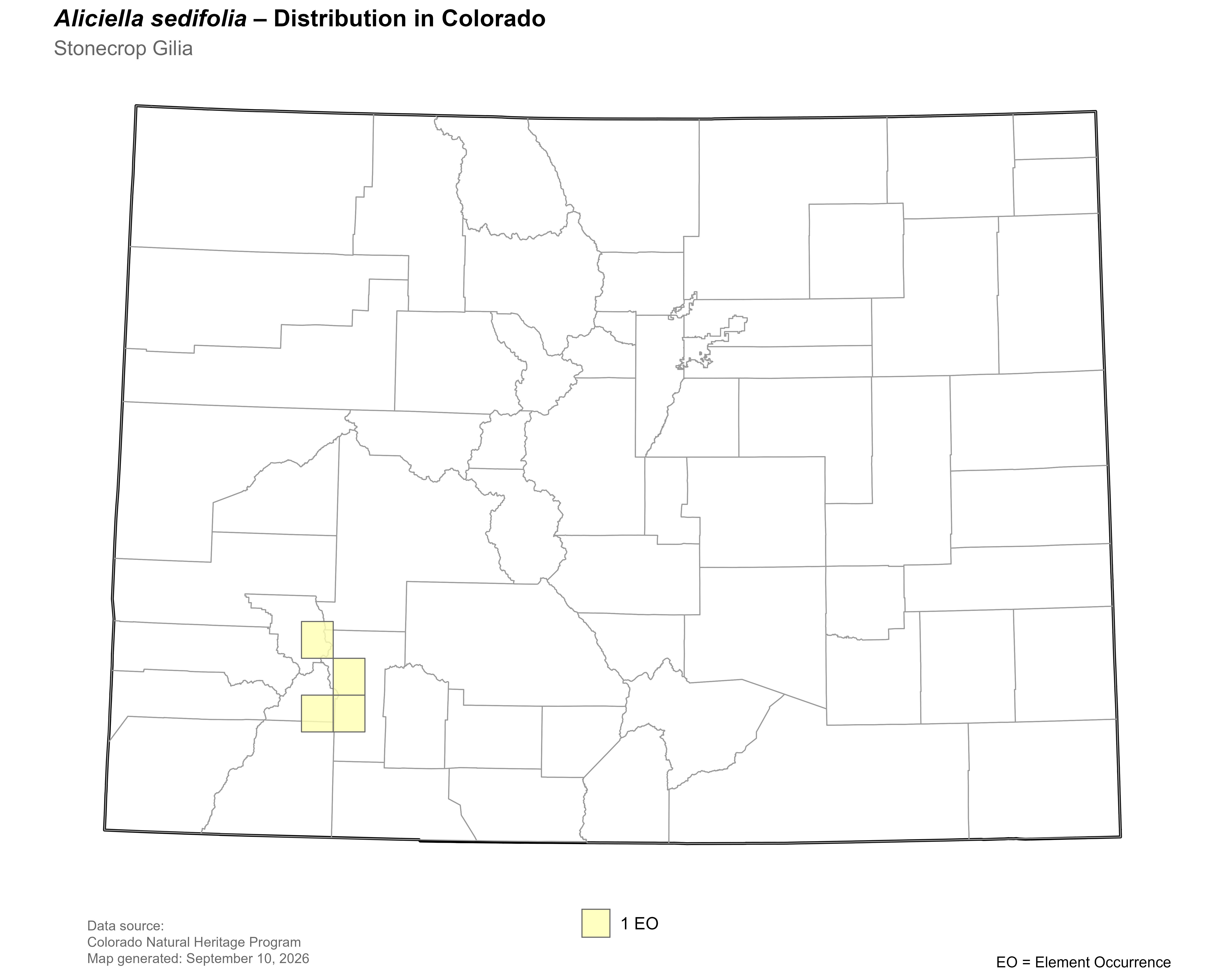
Aliciella sedifolia is endemic to the San Juan Mountains of Hinsdale County, Colorado (USA). The estimated range extent in Colorado of 111 square kilometers was calculated in GeoCAT using occurrence data provided by the Colorado Natural Heritage Program (2023).
Click on map to enlarge |
Threats and Management Issues
The primary threat at this time is considered to be non-motorized recreation (Hogan pers. comm. 2008). This species is found in areas popular for hiking. Other threats, in order of decreasing priority, are off-road vehicle use and other recreation, sheep grazing and its secondary impacts, mining, exotic species invasion, effects of small population size, global climate change, and pollution (Anderson 2004). This species is considered to be extremely vulnerable to climate change (Handwerk et al. 2015).
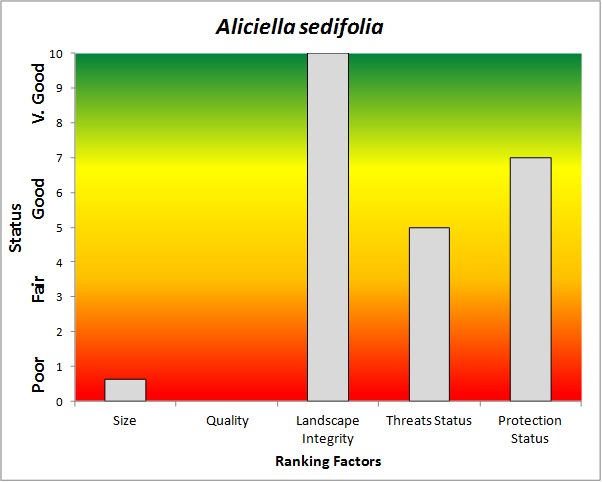
Summary results of an analysis of the status of Aliciella sedifolia based on several ranking factors. This species was concluded to be Moderately Conserved. From Rondeau et al. 2011. |
References
- Anderson, D.G. 2004. Gilia sedifolia Brandeg. (stonecrop gilia): A Technical Conservation Assessment. [Online]. USDA Forest Service, Rocky Mountain Region. http://www.fs.fed.us/r2/projects/scp/assessments/giliasedifolia.pdf [2006-01-09]
- Colorado Natural Heritage Program (CNHP). 2023. Biodiversity Tracking and Conservation System (Biotics 5). Colorado Natural Heritage Program, Colorado State University, Fort Collins.
- Colorado Natural Heritage Program. 2012. Biodiversity Tracking and Conservation System. Colorado State University, Fort Collins, CO.
- Handwerk, J., L. Grunau, and S. Panjabi. 2015. Colorado Wildlife Action Plan: 2015 Rare Plant Addendum. Colorado Natural Heritage Program, Colorado State University, Fort Collins, Colorado, USA.
- Hogan, T. 2008. Personal communication with Colorado Natural Heritage Program staff.
- Komarek, S. 1995. Element occurrence data for Gilia sedifolia. Unpublished report provided to the Colorado Natural Heritage Program.
- Komarek, S. 2003. Plant species of special concern survey form submitted to the Colorado Natural Heritage Program, Boulder, Colorado.
- Porter, J.M. 1998. Aliciella, a recircumscribed genus of Polemoniaceae. Aliso 17(1): 23-46.
- Porter, J.M. 2002. Personal communication with expert on the Polemoniaceae regarding Gilia (Aliciella) sedifolia.
Biotics Export Date : 2026-09-16